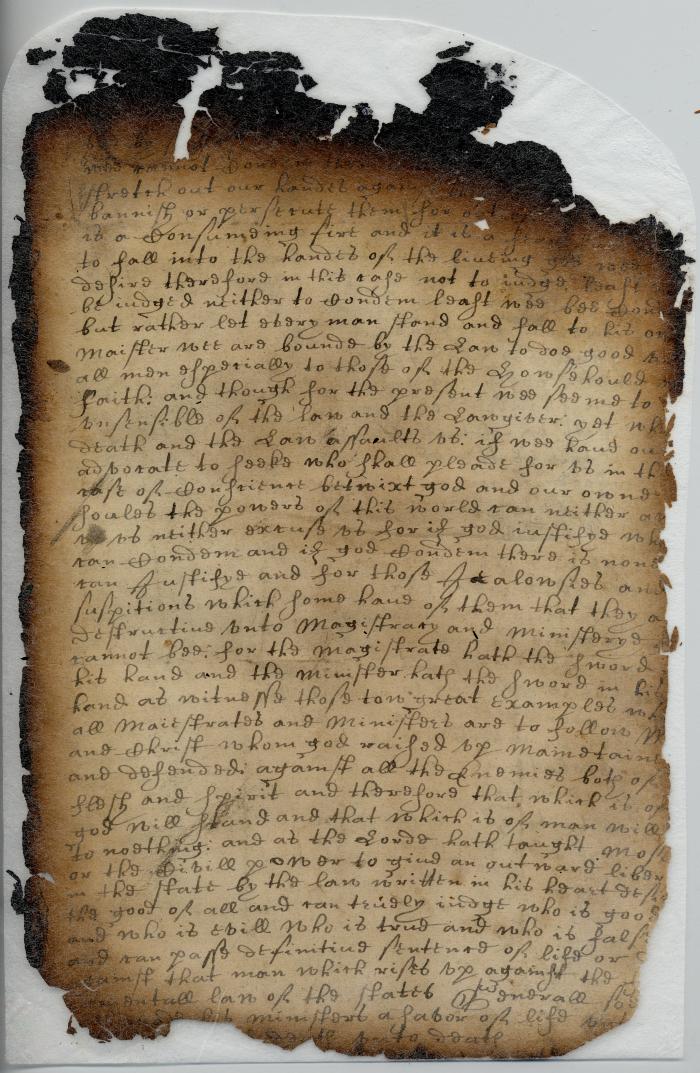
In 1657, residents of the Long Island town of Flushing presented a petition known as the Flushing Remonstrance in response to Stuyvesant’s efforts to suppress Quaker worship. Drawing upon Dutch traditions and Christian principles, the petitioners argued that liberty of conscience should be extended to all people, regardless of religious affiliation.
The Remonstrance declared that the signers could not, in good conscience, deny others the freedom to worship according to their beliefs. Although the petition did not immediately alter colonial policy, it became one of the most celebrated statements of religious liberty in early American history and foreshadowed principles later embedded in the nation’s constitutional tradition.
Taken together, the admission of Jewish settlers and the Flushing Remonstrance demonstrate that New Netherland’s tradition of religious tolerance was becoming an important element of the colony’s civic identity. While imperfectly applied and often contested, tolerance helped distinguish New Netherland from many of its contemporaries and left a lasting imprint on New York’s development.
Sources
Historical Society of the New York Courts. "The Flushing Remonstrance, 1657." https://history.nycourts.gov/about_period/flushing-remonstrance/.
Wikipedia. "The Flushing Remonstrance." https://en.wikipedia.org/wiki/Flushing_Remonstrance.
Further Reading
Haefeli, Evan. New Netherland and the Dutch Origins of American Religious Liberty. University of Pennsylvania Press, 2016.
Shorto, Russell. The Island at the Center of the World: The Epic Story of Dutch Manhattan and the Forgotten Colony that Shaped America. Vintage Books, 2005.