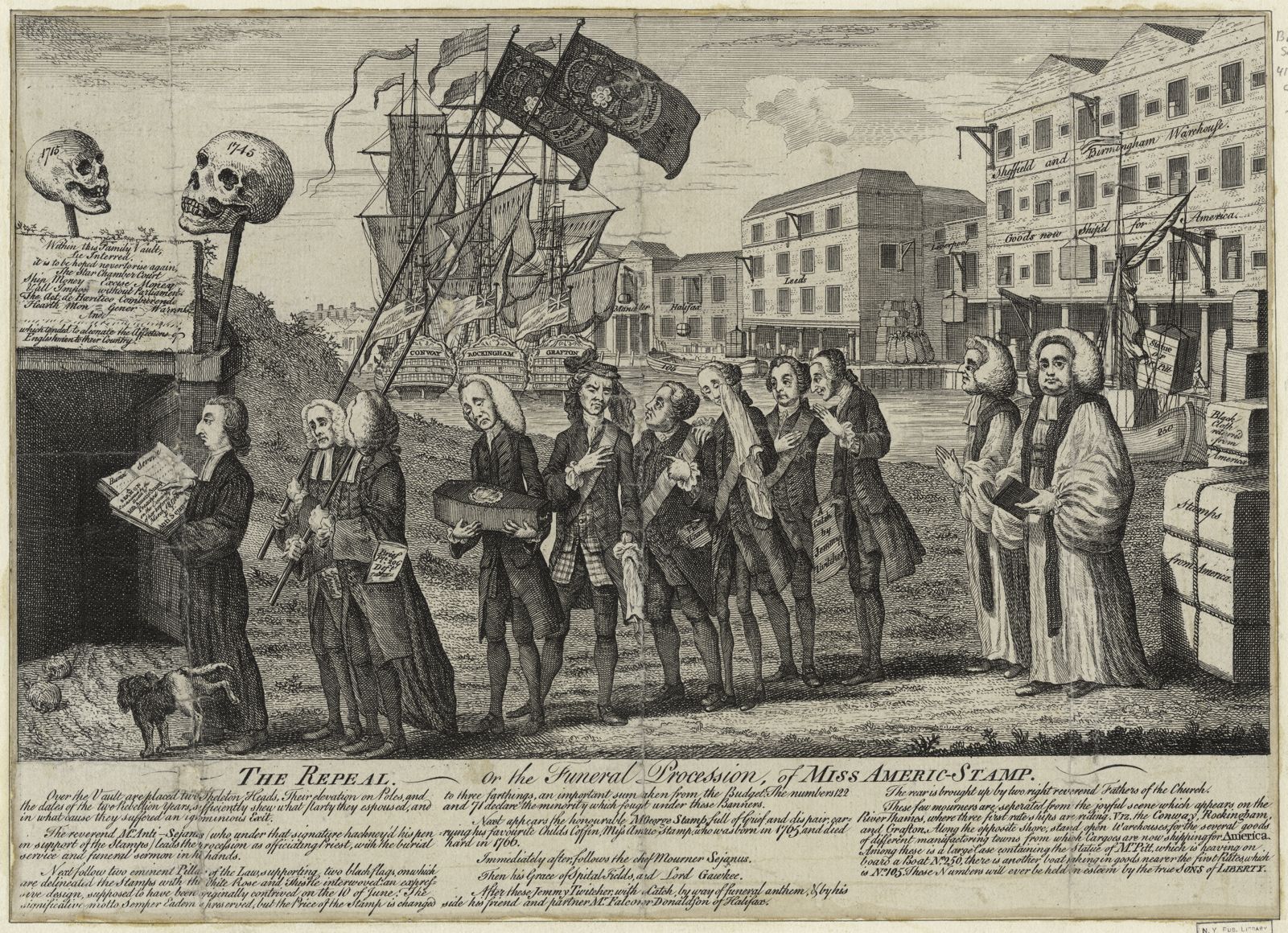
Britain’s victory in the French and Indian War transformed the political landscape of North America. France no longer threatened New York’s northern frontier, but the war left Britain heavily indebted. Seeking revenue to support imperial administration and defense, Parliament enacted a series of new taxes and regulations that many colonists regarded as violations of their rights.
Because New York was both a major commercial center and an important military post, these controversies were felt especially strongly within the colony. Merchants objected to restrictions on trade, while many colonists argued that taxes imposed without colonial consent violated the traditional rights of Englishmen.
The Stamp Act of 1765 produced particularly intense opposition. Public protests erupted in New York City and elsewhere. Merchants organized boycotts, crowds demonstrated against imperial policies, and groups such as the Sons of Liberty emerged as powerful forces in colonial politics.
New York played a central role in the colonial response. The Stamp Act Congress met in the city in 1765, bringing together representatives from several colonies to coordinate opposition. Like the Albany Congress a decade earlier, the gathering demonstrated the growing willingness of colonists to think and act collectively.
The controversy surrounding the Stamp Act represented more than opposition to a single tax. It reflected deeper questions that had been developing for generations: Who possessed legitimate political authority? What rights did colonists enjoy? How should power be divided between local assemblies and imperial institutions?
These debates increasingly occupied the attention of New Yorkers from every level of society.
Sources
Wikipedia. "Stamp Act Congress." Last edited September 20, 2026. https://en.wikipedia.org/wiki/Stamp_Act_Congress
The Gilder Lehrman Institute of American History. "The Stamp Act, 1765: A Spotlight on a Primary Source by George III." https://www.gilderlehrman.org/history-resources/spotlight-primary-source/stamp-act-1765.
Further Reading
Morgan, Edmund and Helen Morgan. The Stamp Act Crisis: Prologue to Revolution. UNC Press, 1995.
Hutchins, McLeod Zachary, ed. Community without Consent: New Perspectives on the Stamp Act. Dartmouth College Press, 2016.
Journal of the First Congress of the American colonies in opposition to the tyrannical acts of the British Parliament held at New-York, October 7, 1765. New York: 1765. https://borrow.nypl.org/search/card?id=ee7e7fb4-2356-5307-b207-fde8a5790155&entityType=FormatGroup.