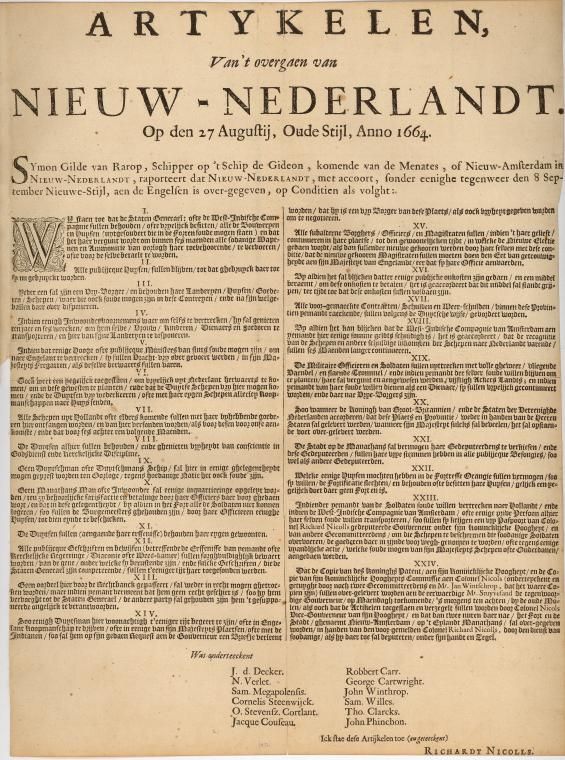
The English conquest marked a turning point in New York’s history, but not a sharp break with its past. Unlike many colonial conquests, the transfer of New Amsterdam in 1664 occurred with remarkably little bloodshed, and many of the institutions, customs, and traditions established under Dutch rule survived long afterward.
In 1664, an English fleet entered New York Harbor and demanded the surrender of New Amsterdam. Governor Peter Stuyvesant initially favored resistance, but many of the colony’s merchants and civic leaders saw little advantage in fighting. Faced with overwhelming force and limited public support, Stuyvesant agreed to surrender. The transfer of New Amsterdam to English control was one of the most consequential bloodless handovers in colonial American history.
The transition was overseen by Colonel Richard Nicolls, the first English governor of New York. A trusted representative of the Duke of York and one of four royal commissioners sent to strengthen royal oversight in New England and monitor developments throughout the region, Nicolls managed the transfer with notable pragmatism.
The Articles of Capitulation negotiated between the Dutch and English guaranteed the protection of property rights, inheritance, existing contracts, and freedom of worship. Nicolls honored those commitments, preserving Dutch legal customs and permitting continued religious practice.
His policies reflected both practical politics and the realities of a colony already accustomed to ethnic and religious diversity. In this respect, English rule reinforced rather than erased one of New Netherland’s most enduring characteristics.
The colony was renamed New York in honor of the Duke of York, the future King James II. Yet Dutch culture remained deeply embedded in society. Dutch churches flourished, Dutch continued to be spoken throughout much of the Hudson Valley, and Dutch legal customs persisted for generations.
The English conquest therefore marked not the end of New Netherland’s legacy but its transformation. New York would become an English colony, yet it would remain profoundly influenced by Dutch traditions of commerce, local self-government, and religious tolerance.
Those traditions, combined with the colony’s strategic geography and longstanding relationships with Native nations, laid the foundations for the remarkable growth and influence New York would achieve during the eighteenth century.