No individual was more influential in frontier affairs than Sir William Johnson, who settled in the Mohawk Valley and became Britain’s Superintendent of Indian Affairs for the Northern Department. Through diplomacy, trade, and personal relationships, Johnson cultivated close ties with the Haudenosaunee Confederacy and became one of the most powerful figures in colonial New York.
Among Johnson’s most important allies was the Mohawk leader Hendrick Theyanoguin, known to the British as King Hendrick. A respected diplomat and warrior, Hendrick played a central role in relations between the Confederacy and the British during the mid-eighteenth century.
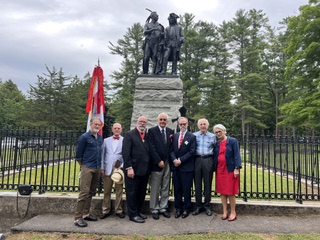
A monument overlooking Lake George, erected in 1904 by the Society of Colonial Wars in the State of New York, commemorates their partnership. The sculpture depicts Johnson and Hendrick discussing strategy before the Battle of Lake George in 1755. According to a well-known tradition, Johnson proposed dividing his forces, whereupon Hendrick broke a single arrow and then demonstrated that several arrows bound together could not easily be broken. The lesson was clear: unity was strength.
Whether literally true or refined through retelling, the story captures an essential reality of colonial New York: British success on the frontier depended heavily upon Native allies whose experience and judgment commanded respect.