
French and Indian War Spotlight
The French and Indian War (1754-1763) was the North American phase of the global Seven Years’ War fought between several major European powers over territories around the world. The conflict stretched along the East coast all the way up into French-controlled Canada, with key campaigns waged throughout what is now New York State, including at Lake George and Champlain, and at Forts William Henry, Crown Point, and Ticonderoga. At the outset of the war, the French controlled territory along the St. Lawrence River valley through what is now New Brunswick and Nova Scotia, with additional settlements concentrated around New Orleans and along the Mississippi River. The British colonies extended along the Atlantic coast from Newfoundland to Georgia, with additional claims to trading sites in Rupert’s Land, where the Hudson Bay Company operated. Though they claimed these territories as subsidiaries of their respective crowns, there were significant indigenous populations throughout, with their own independent and robust governmental structures and societies. These tribes were trading and military allies to the European colonists, and as such became embroiled in the conflicts between them. The Haudenosaunee Confederacy allied primarily with the British forces, while the French recruited aid from tribes throughout the Great Lakes region, including the Ojibwas, Potawatomi, and Winnebagos.
Major Battles
The Battle of Lake George (1755)
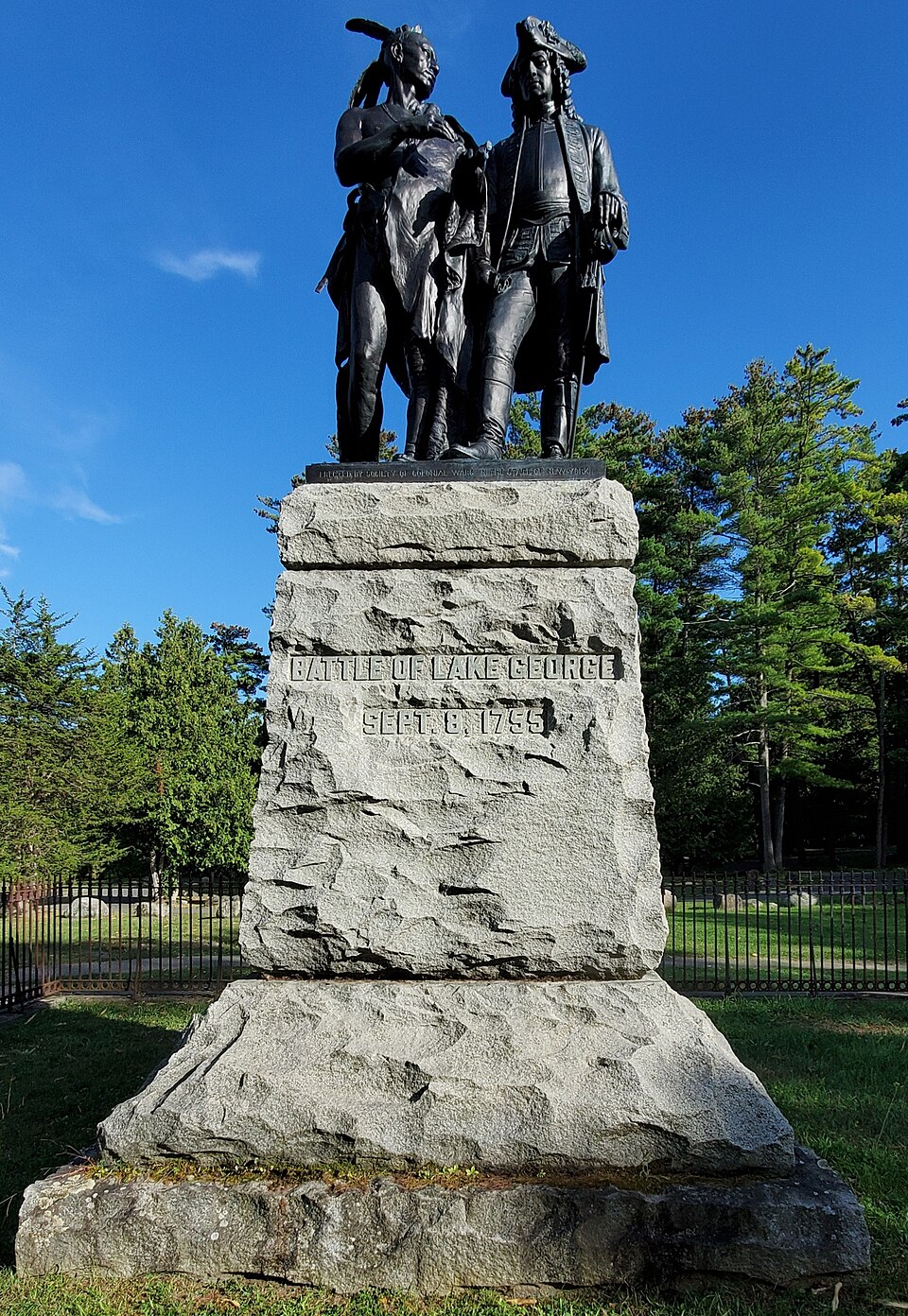
The Battle of Lake George is one of special importance to our Society, for it is said to be the origin of our “Broken Arrows Ceremony,” and its memorialization has been one of the New York Society’s projects since the early 20th century. Fought on the 8th of September 1755, this conflict was part of the campaign fought by the allies Sir William Johnson and King Hendrick Theyanoguin of the Haudenosaunee. William Johnson was a British army officer and colonial administrator, who became closely associated with the Mohawk people and learned their language and customs, leading to his appointment as official liaison with the Haudenosaunee. He worked closely in this position with Hendrick Theyanoguin, a chief of the Mohawk, fighting with him throughout the King George’s War.
In 1755, Johnson was tasked with capturing the French-controlled Fort St. Frederic, an important defense point for Canada. While en route from Albany Johnson’s British forces renamed the Lac du Saint Sacrement to Lake George, in honor of the English King George II, and established a route from the newly christened lake to Lake Champlain. They did not make it far, however, as French forces were alerted to their presence and made their way to the banks of Lake George, preparing to engage the British there. Johnson held an emergency meeting, where he was advised by his Mohawk allies not to split up his force, but rather to show strength in unity, as “several arrows bound together could not easily be broken.” On the morning of September 8, 1755 Johnson sent some 1,800 men to reinforce Fort Edward under the command of Theyanoguin and Colonel Ephraim Williams. They were ambushed by the French in what has come to be known as the “Bloody Morning Scout,” and both commanders were killed in the fight. The French then advanced on the British camp at Lake George, where Johnson had constructed defensive barricades in preparation. Despite their earlier success, the British defeated these French forces, and tendered their commander Dieskau’s surrender.
The Battle of Fort William Henry (1757)
Between the 3rd and 9th of August, 1757, French General Louis-Joseph de Montcalm led a siege against the British-held Fort William Henry, which sat on the border between British New York and French Canada, on the southern edge of Lake George. Both the British and French worked to take command of the area surrounding Lake George in the years following the 1755 conflicts, building the Forts Ticonderoga, William Henry and Edward within quick succession of each other.
When the French arrived at Fort William Henry, it was held by a small group of soldiers under the command of Lieutenant Colonel George Monro. Montcalm laid siege to the fort, firing on it continually until Monro surrendered under the condition that he would be protected on his withdrawal to Fort Edward. Montcalm’s indigenous allies violated the terms of this surrender and attacked the fleeing British forces, who had been rendered unable to protect themselves. Around 200 people were killed and many others, including women and children, taken captive in an event which lived on in the memories of the British for the rest of the war. Historians disagree on the reasons for the attack, the historical record clouded by inflated accounts from the time which termed the event a massacre and claimed over 1,500 dead. Montcalm’s participation in or sanctioning of his allies’ actions is similarly debated.
British commanders at Fort Edward failed to respond to the crisis, seemingly unwilling to send more of their forces into what he believed to be a much larger French army. Brigadier General Daniel Webb who commanded Ft. Edward was recalled, and Monro died in November of the same year, some say in anger over the situation.
The Battle of Fort Ticonderoga (1758)
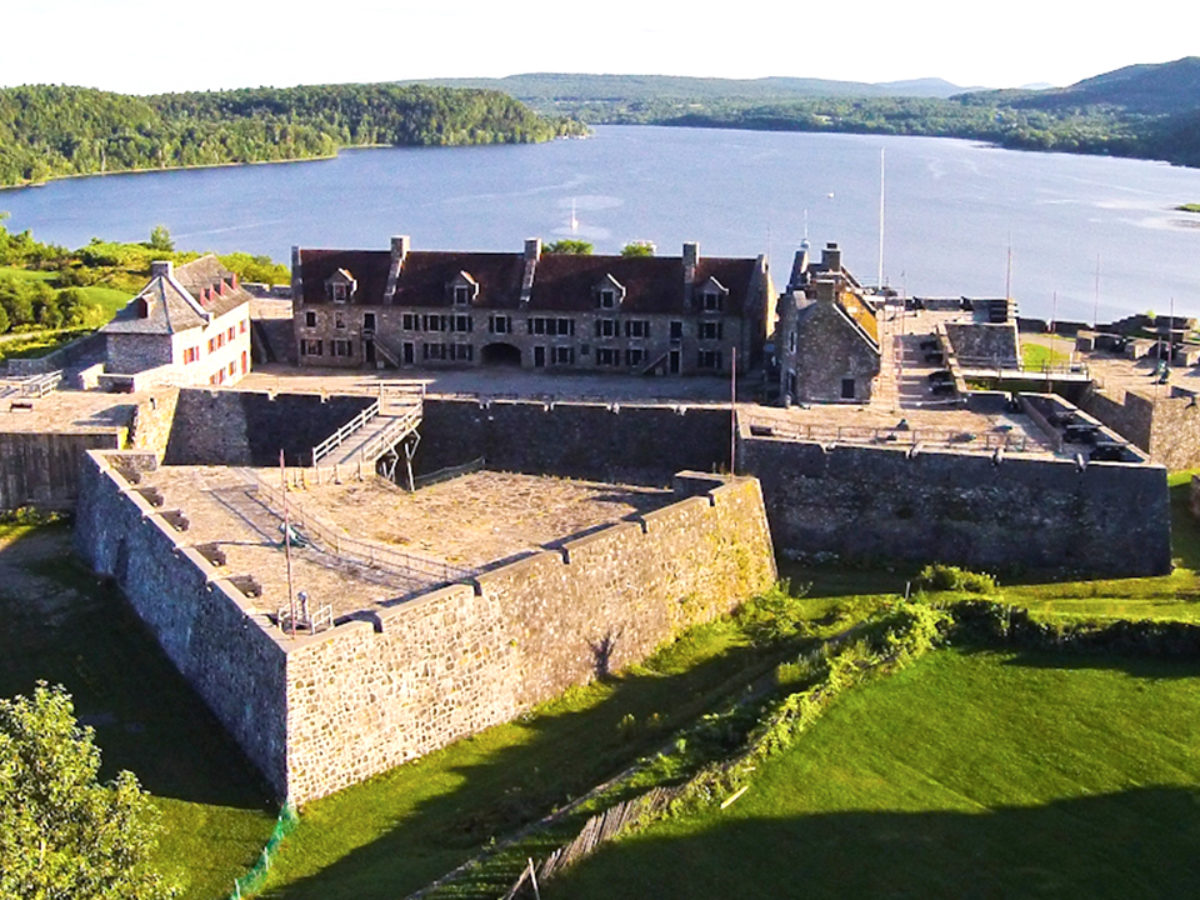
Fort Carillon, later renamed to Fort Ticonderoga under British control, was built by French forces in October of 1755 on the place where Lakes George and Champlain converge in preparation for a British attempt on Canada. This was a useful strategic point which had historically been used by indigenous strategists in their conflicts, as the lakes created a kind of bottleneck, preventing invading forces from moving further north with ease. In 1757, the fort was manned by Major Louis-Joseph de Montcalm, who successfully took the British Fort William Henry in the summer of that year. In 1758, alarmed by the loss of their fort, the British amassed an army of 16,000 men under the command of General Abercrombie and Brigadier General Lord Howe and moved to attack Fort Carillon. Though the fort was still under construction and manned only by 3,600 French and Abenaki soldiers, the French forces dug deep trenches and scattered throughout the forest, surrounding the British with cannon and spiked reinforcements. Despite their advantage, the British were badly defeated, with 551 soldiers killed and over 1,000 wounded.
The following year the British again made an attempt at the fort, this time under the command of Lord Jeffrey Amherst. Instead of fighting, the French forces attempted to destroy the stronghold by blowing up their ammunition. This failed to severely damage the building, however, and the British took command of the fort, renaming it to Ticonderoga. The fort remained an important military stronghold for the British through to the revolution, when colonial militia forces - some of whom had been present at the original battle in 1758 - successfully attacked and took control of the area.
Battle at Fort Niagara (1759)
Following plans made by Jeffrey Amherst for campaigns for the year 1759, Brigadier General John Prideaux and Sir William Johnson were tasked with the besieging and capturing of Fort Niagara, on Lake Ontario. The fort was French controlled, and in early 1759 housed as many as 3,000 men. That June, however, many of those forces had been sent south, leaving only 500 behind. On July 6, Prideaux brought 3,200 men, sailing across Lake Ontario and landing in secret near the fort to begin laying siege. The French forces held out for 20 days, but capitulated after a relief force approaching from the south were ambushed and defeated by the British at the Battle of La Belle-Famille on the 24th of July. Prideaux was killed in the conflict, and Sir William Johnson took command.
The French defeat at Fort Niagara coincided with the British win at Fort Ticonderoga, and opened the northern frontier up to British advance as the French retreated further into Canada. By September of 1759, British General James Wolf had successfully captured Quebec City after a three-month siege, and then Montreal a year later, marking the end of the French and Indian War with the signing of the Articles of Capitulation and the official transference of the colony of Canada to the British crown.
Life During the War
The War's Aftermath
Takeaways
While the French and Indian War raged throughout North America, New York’s frontier spaces hosted the front line of the struggle for British and French control of the New World, its strategic position between Canada, New England, the Atlantic coast and the interior making it the crux of imperial rivalry. These battles therefore shaped not only the future of the colony itself, but determined the future balance of power on both the continent and across the globe. They also fundamentally changed the political, social and economic landscape of New York, strengthening military institutions and allegiances with indigenous allies, and setting the stage for revolution against British rule.
The stories of the French and Indian War give us a rich view into the complex webs of allegiance and identity that bound colonists, imperial authorities, and indigenous populations in the pre-Revolutionary world. They give weight to the radical changes these people lived through and participated in, allowing for an understanding of the shifting relationships that occurred between these conflicts and those of the American Revolution. A study of the places and battlefields themselves offer a rich illustration of this, grounding wide-ranging historical trends and forces in the lived experiences of the people who enacted them.
Want to Engage More with This History?
The sites of the battles at Lake George and Fort Ticonderoga have been lovingly and expertly restored, and continue to uncover and preserve their histories to this day. Visit the Lake George Battlefield Park to see our Society's monument to Sir William Johnson and King Hendrick Theyanoguin, or take a trip to Fort Ticonderoga for their wonderful exhibitions and reenactments.
From the Archives
Our Warriors with particular interest in the French and Indian Wars can explore any of the wonderful rare books and manuscripts in our collections! Follow the links below to request viewings.
Fort Ticonderoga and the German Redoubt by Alfred Bell and Howland Pell (1912)
The Niagara Campaign of 1759 by George Douglas Emerson (1906)
Journal Kept by Sergeant David Holden (1899)