
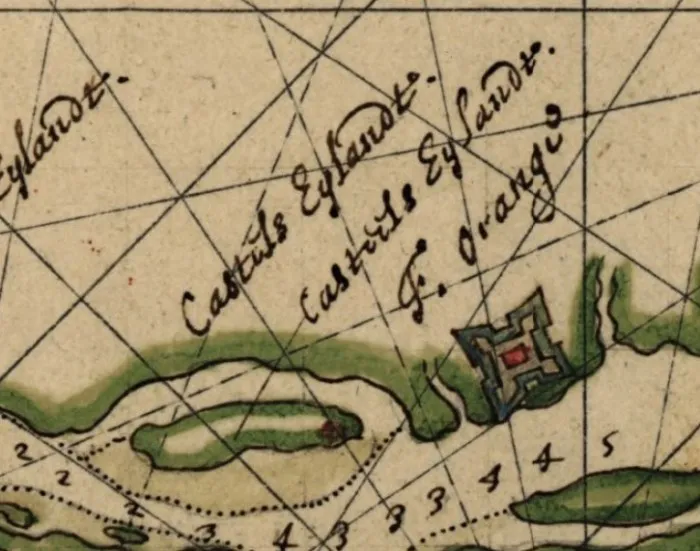
Fort Nassau, later the site of Fort Orange and then modern-day Albany, was built in 1614 on an island in the Hudson River. This first Dutch settlement in North America was located at the crossroads of centuries-old indigenous trading networks, and served as a nexus for Dutch fur traders who sought to gain entry into those relationships in order to extract beaver pelts. According to indigenous tradition, these trading relationships between the Dutch government and local tribes – specifically Haudenosaunee Mohawk and Mohican in that area of upstate New York - were formalized in what is known as the “Two Row Wampum Treaty,” also called the Guswenta, Kaswentha or Tawagonshi Agreement in 1613, the year prior to the building of Fort Nassau. While it is clear to historians that some kind of agreement was entered into, they disagree on the extent to which European and indigenous understandings on the event align as there is no corresponding extant Dutch record.
Formal treaty or no, the events of 1613 created the conditions for Dutch colonization to begin in earnest, and they quickly made moves to formally establish the colony of New Netherlands, creating the New Netherland Company and building Fort Nassau as a physical manifestation of their colonial presence in the area. The site remained a crucial economic and military base throughout Dutch and English colonial rule, and remains the modern-day capital of New York State.
Sources
Wikipedia. “Fort Nassau (North River).” https://en.wikipedia.org/wiki/Fort_Nassau_(North_River).
Wikipedia. “Fort Orange (New Netherland).” https://en.wikipedia.org/wiki/Fort_Orange_(New_Netherland).
Wikipedia. “Two Row Wampum Treaty.” https://en.wikipedia.org/wiki/Two_Row_Wampum_Treaty.
New York State Museum. “A small fort, which our people call Fort Orange.” https://nysm.nysed.gov/exhibitions/ongoing/fort-orange.
Further Reading
New York Almanac. “Fort Nassau Archives.” https://www.newyorkalmanack.com/tags/fort-nassau/.