
Colonial History Timeline
Learn More about the Rich History of New York State
Indigenous Peoples of New York
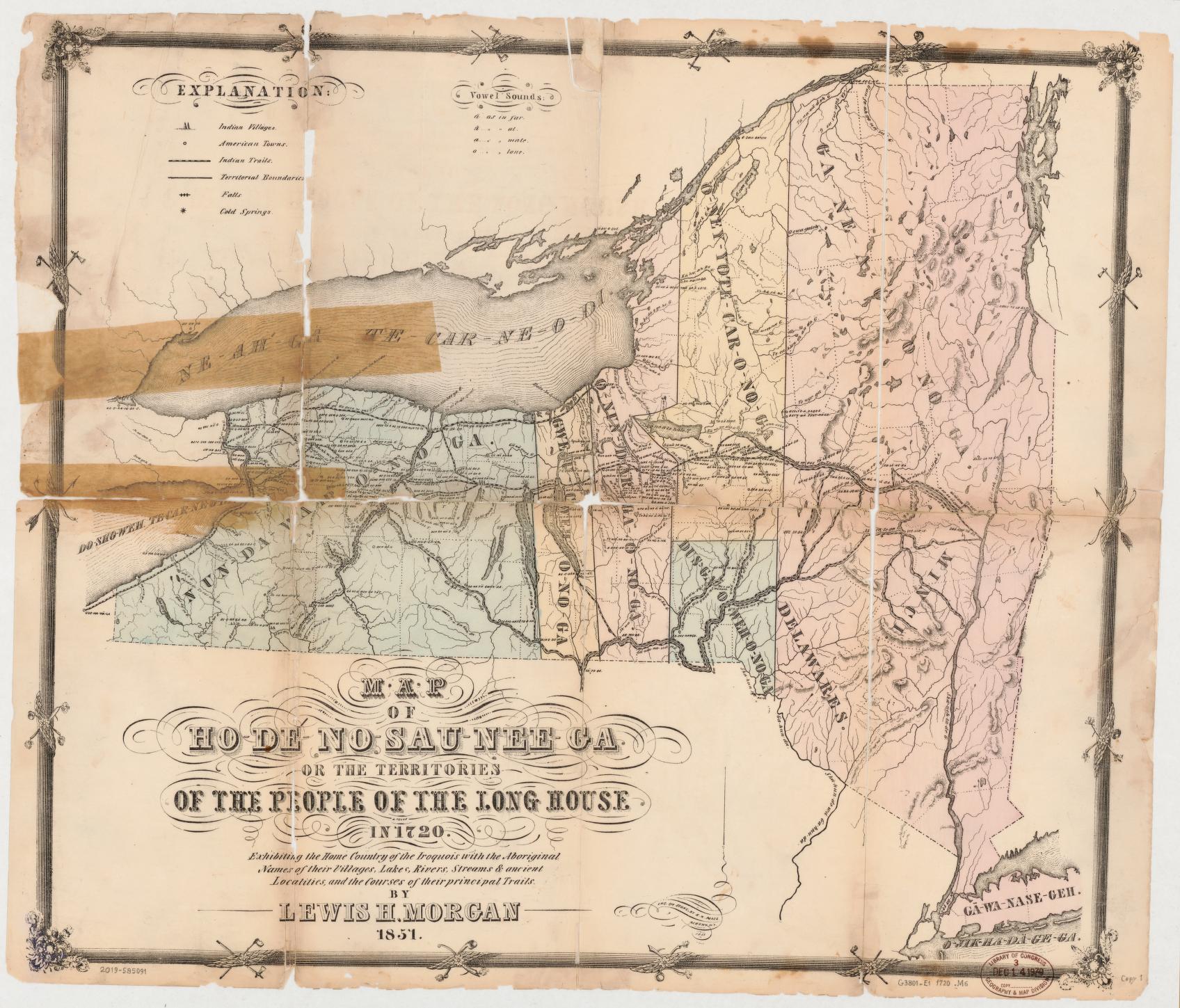
The region that is now New York State was home to numerous powerful Indigenous nations, particularly the Haudenosaunee Confederacy made up of the Mohawk, Oneida, Onandaga, Cayoga and Seneca nations.
Indigenous Peoples of New York
In the centuries before Europeans arrived, the region was home to numerous Indigenous nations. Most influential was the Haudenosaunee, or Iroquois, Confederacy, a powerful alliance of the Mohawk, Oneida, Onondaga, Cayuga, and Seneca nations, later joined by the Tuscarora. The Confederacy is increasingly referred to today by its own name, Haudenosaunee, meaning “People of the Longhouse,” although the term Iroquois remains familiar in historical literature. The Confederacy created one of the most durable and sophisticated political alliances in North American history, predating European settlement and exerting influence across much of the Northeast.
The fur trade became the foundation of New Netherland’s economy. Dutch traders exchanged European goods for beaver pelts obtained through Indigenous trade networks that extended deep into the interior. Fort Orange emerged as the principal center of this commerce, linking Atlantic markets with Native trading routes stretching toward the Great Lakes and beyond.
Native peoples were never passive participants in this system. They were diplomats, military allies, traders, and political strategists whose decisions shaped the colony’s future. The Haudenosaunee Confederacy skillfully balanced relations with competing European powers and maintained its influence for generations.
The strategic importance of Albany derived largely from these relationships. As the principal northern settlement of New Netherland, it became a meeting ground where Native leaders, traders, and colonial officials negotiated alliances, exchanged goods, and shaped the future of the region. The success of New Netherland depended as much upon diplomacy as commerce.
Sources
Barnard College. "A Tour of Native New York." https://barnard.edu/news/tour-native-new-york.
Haudenosaunee Confederacy. "Who We Are." https://www.haudenosauneeconfederacy.com/who-we-are/.
Wikipedia. "Haudenosaunee." https://en.wikipedia.org/wiki/Haudenosaunee.
Further Reading
Center for Brooklyn History’s Research Guide
Indigenous Peoples of Long Island and New York | Brooklyn Public Library.
Grumet, Robert. First Manhattans: A History of the Indians of Greater New York. 2011.
Murray, David. Indian-Giving: Economics of Power in Indian-White Exchanges. Amherst: University of Massachusetts, 2000.
Oberg, Michael. The Central Fire of the Iroquois: A Five-Hundred-Year History of the Onondaga Nation. Yale University Press, 2026.
1609: Henry Hudson Arrives in North America
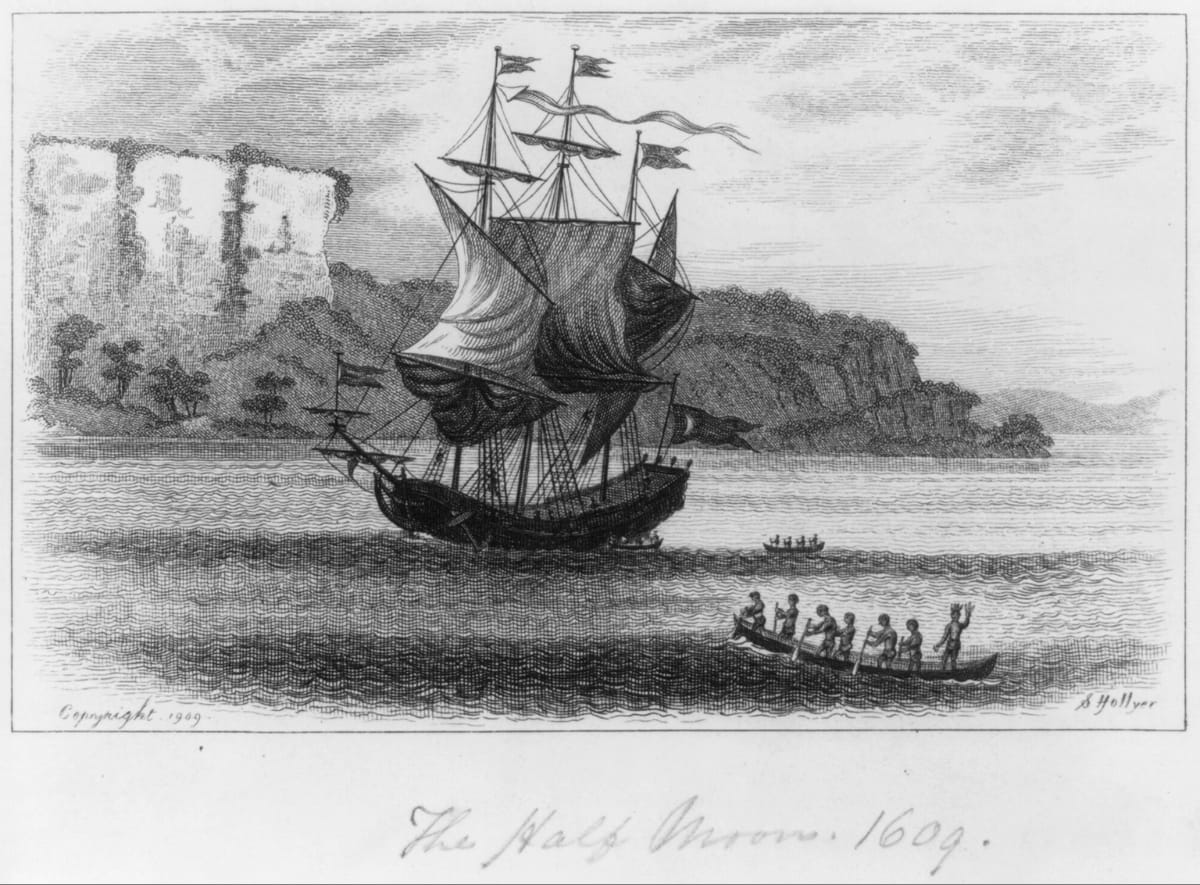
In 1609, English navigator Henry Hudson, sailing on behalf of the Dutch East India Company, explored the river that now bears his name.
1609: Henry Hudson Arrives in North America
The origins of colonial New York lie in the Dutch Republic’s search for commercial opportunity during the seventeenth century. In 1609, the English navigator Henry Hudson, sailing on behalf of the Dutch East India Company, explored the river that now bears his name. Although he failed to discover the long-sought passage to Asia, his voyage revealed a region rich in natural resources and ideally situated for trade.
Sources
Wikipedia. "Henry Hudson." https://en.wikipedia.org/wiki/Henry_Hudson.
Further Reading
Bick, Alexander. Minutes of Empire: Dutch West India Company Politics, 1618-1648. Oxford University Press, 2026.
Bown, Stephen R. Merchant Kings: When Companies Ruled the World, 1600-1900. New York: Thomas Dunne Books, 2010.
Hancock, James. From John Cabot to Henry Hudson: Early European Arrivals in Northeastern and Mid-Atlantic North America. McFarland, 2025.
Hunter, Douglas. Half Moon: Henry Hudson and the Voyage that Redrew the Map of the New World. Bloomsbury Press, 2009.
1614: Construction of Fort Nassau
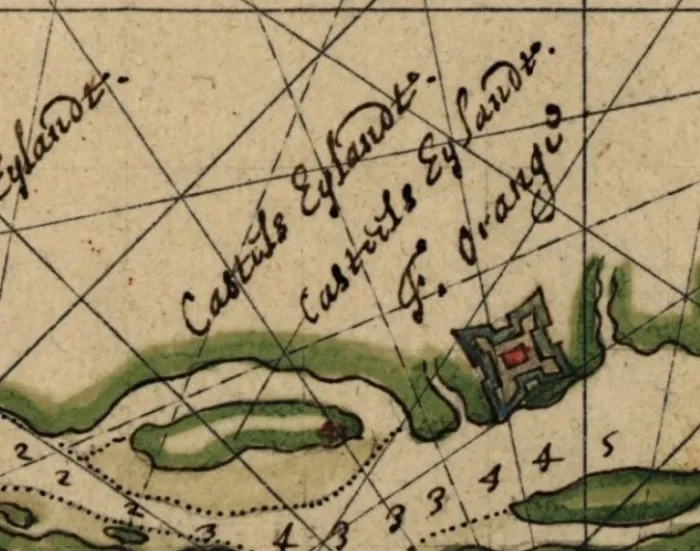
Fort Nassau, the first permanent Dutch settlement in the New Netherlands, was constructed at the crossroads of existing hunting and trapping routes, allowing the Dutch access to indigenous fur trading networks.
1614: Construction of Fort Nassau
Fort Nassau, later the site of Fort Orange and then modern-day Albany, was built in 1614 on an island in the Hudson River. This first Dutch settlement in North America was located at the crossroads of centuries-old indigenous trading networks, and served as a nexus for Dutch fur traders who sought to gain entry into those relationships in order to extract beaver pelts. According to indigenous tradition, these trading relationships between the Dutch government and local tribes – specifically Haudenosaunee Mohawk and Mohican in that area of upstate New York - were formalized in what is known as the “Two Row Wampum Treaty,” also called the Guswenta, Kaswentha or Tawagonshi Agreement in 1613, the year prior to the building of Fort Nassau. While it is clear to historians that some kind of agreement was entered into, they disagree on the extent to which European and indigenous understandings on the event align as there is no corresponding extant Dutch record.
Formal treaty or no, the events of 1613 created the conditions for Dutch colonization to begin in earnest, and they quickly made moves to formally establish the colony of New Netherlands, creating the New Netherland Company and building Fort Nassau as a physical manifestation of their colonial presence in the area. The site remained a crucial economic and military base throughout Dutch and English colonial rule, and remains the modern-day capital of New York State.
Sources
Wikipedia. “Fort Nassau (North River).” https://en.wikipedia.org/wiki/Fort_Nassau_(North_River).
Wikipedia. “Fort Orange (New Netherland).” https://en.wikipedia.org/wiki/Fort_Orange_(New_Netherland).
Wikipedia. “Two Row Wampum Treaty.” https://en.wikipedia.org/wiki/Two_Row_Wampum_Treaty.
New York State Museum. “A small fort, which our people call Fort Orange.” https://nysm.nysed.gov/exhibitions/ongoing/fort-orange.
Further Reading
New York Almanac. “Fort Nassau Archives.” https://www.newyorkalmanack.com/tags/fort-nassau/.
1624: The Colony of New Netherland is Established
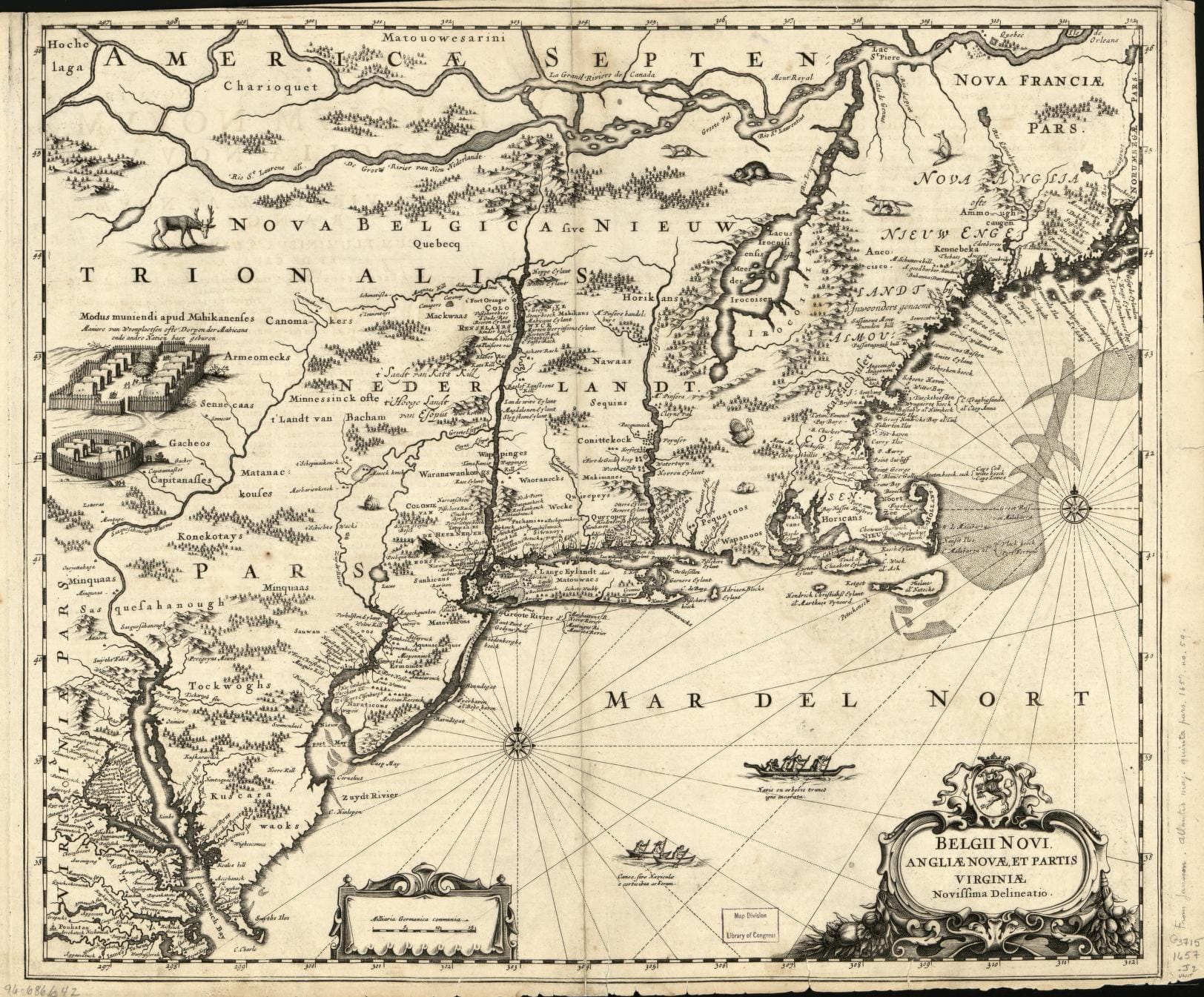
The Dutch West India Company established the colony of New Netherland in 1624, and settlements soon grew up along the Hudson River, including at the capital, New Amsterdam (present-day New York).
1624: The Colony of New Netherland is Established
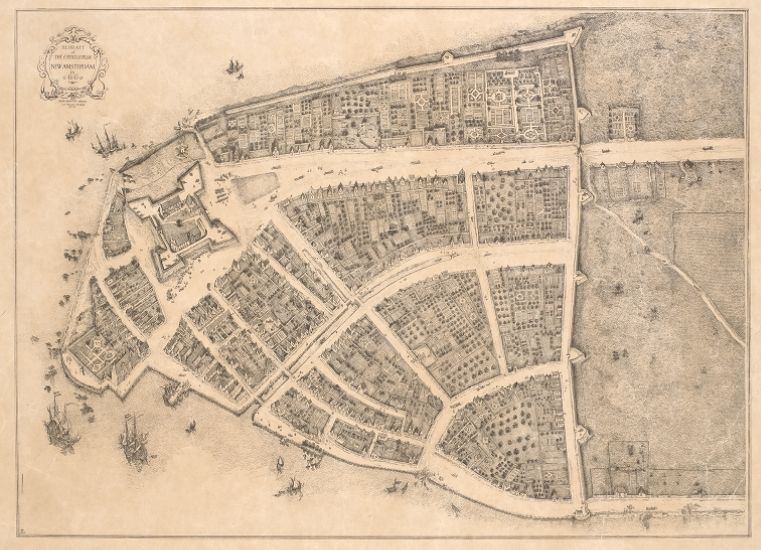
To capitalize on the opportunities presented by Henry Hudson's discovery, the Dutch West India Company established the colony of New Netherland in 1624. Settlements soon appeared at Fort Orange, near present-day Albany, and at several points along the Hudson River. The colony’s capital, New Amsterdam, occupied the southern tip of Manhattan Island, where a deep natural harbor offered extraordinary advantages for shipping and commerce.
Sources
Shorto, Russell. The Island at the Center of the World: The Epic Story of Dutch Manhattan and the Forgotten Colony that Shaped America. Vintage Books, 2004.
Wikipedia. "New Netherlands." https://en.wikipedia.org/wiki/New_Netherland.
Further Reading
Jacobs, Jaap. The Colony of New Netherland: A Dutch Settlement in Seventeenth-Century America. Cornell University Press, 2009.
New York State Archives. "Researching New York's Dutch Heritage." https://www.archives.nysed.gov/research/research-guide-dutch.
Rink, Oliver. Holland on the Hudson: An Economic and Social History of Dutch New York. Cornell University Press, 1986.
Shorto, Russell. The Island at the Center of the World: The Epic Story of Dutch Manhattan and the Forgotten Colony That Shaped America. Vintage Books, 2004.
van den Hout, J. Adriaen van der Donck: A Dutch Rebel in Seventeenth-Century America. Albany: Excelsior Editions, 2018.
Van der Donck, Adriaen. A Description of the New Netherlands. 1655.
1626: Peter Minuit Purchases the Island of Manhattan
In 1626, Peter Minuit purchased the island of Manhattan from the Lenape people, a symbol of the colony's commercial outlook and its reliance upon negotiation, exchange, and diplomacy.
1626: Peter Minuit Purchases the Island of Manhattan
Among the colony’s most important figures was Peter Minuit, traditionally associated with the purchase of Manhattan in 1626. Whether the transaction occurred exactly as later generations imagined, Minuit became a symbol of the colony’s commercial outlook and its reliance upon negotiation, exchange, and diplomacy.
Born in the German city of Wesel and raised in a family of Walloon background, Minuit brought extensive commercial experience to New Netherland. Appointed director of the colony in 1626, he sought to strengthen Dutch claims to the region while encouraging settlement and trade. His administration helped establish Manhattan as the colony’s commercial center and laid foundations for New Amsterdam’s future growth.
Unlike many English colonies founded for religious purposes, New Netherland was established as a commercial enterprise. Trade shaped its development from the beginning. Merchants, sailors, artisans, and farmers arrived from across Europe, creating one of the most diverse populations in colonial North America.
Sources
Museum of the City of New York. "Peter Minuit." https://www.mcny.org/peter-minuit.
Wikipedia. "Peter Minuit." https://en.wikipedia.org/wiki/Peter_Minuit.
Further Reading
the Gotham Center for New York History. "Notes on the Manhattan Purchase." https://www.gothamcenter.org/blog/notes-on-the-manhattan-purchase.
Schaghen, Peter. "Peter Schaghen Letter." The New Netherland Institute, Albany, NY. https://web.archive.org/web/20101023083225/http://www.nnp.org/nnp/documents/schagen_main.html.
Shorto, Russell. The Island at the Center of the World: The Epic Story of Dutch Manhattan and the Forgotten Colony that Shaped America. Vintage Books, 2004.
1627: Enslaved Africans brought to New Amsterdam
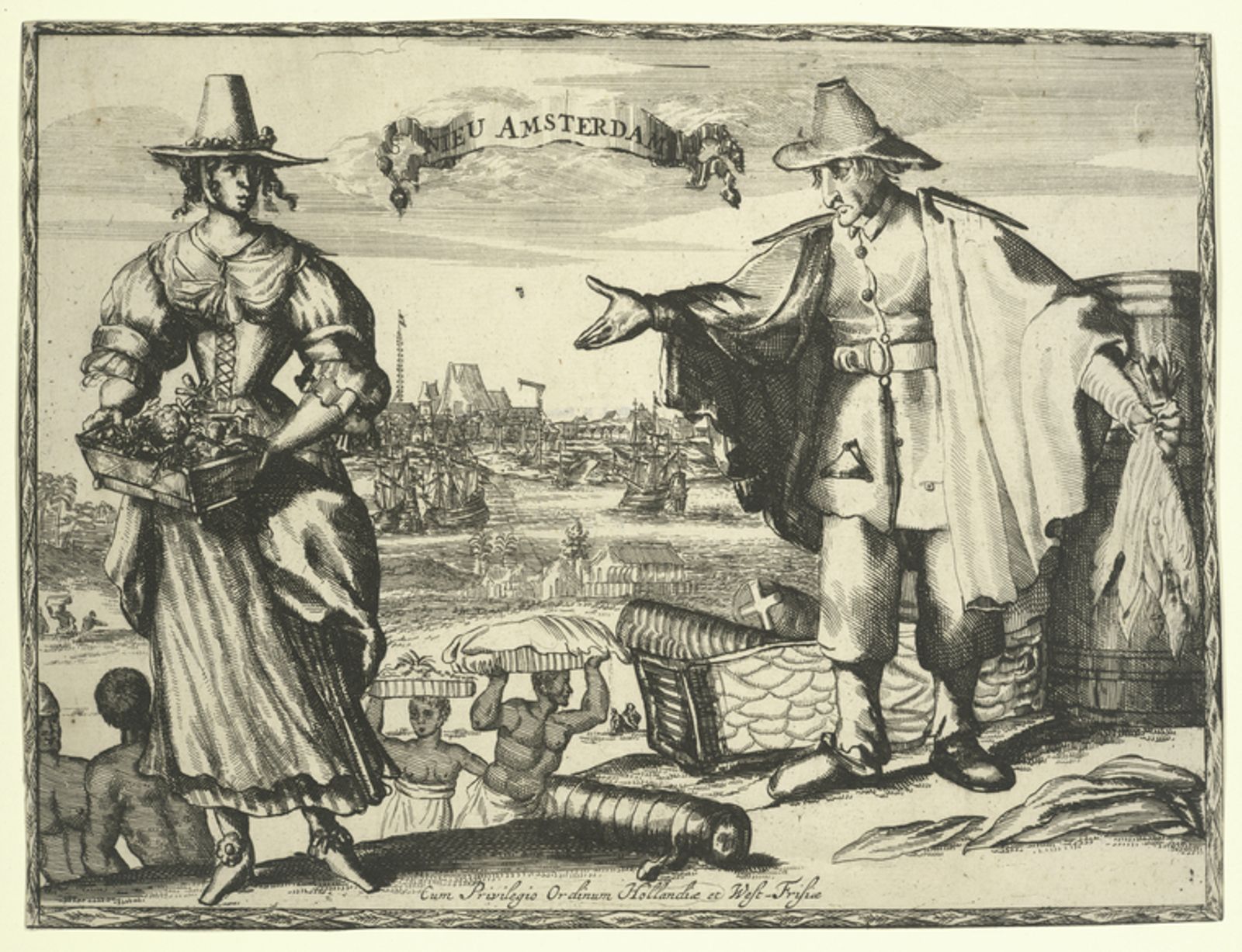
A group of eleven enslaved African men were brought to the city of New Amsterdam on August 29, 1627. The first of many such groups, their forced labor helped to build the city's early infrastructure, including clearing farmland and erecting buildings for the Dutch colonists.
1627: Enslaved Africans brought to New Amsterdam
On August 29, 1627 the ship Bruynvisch arrived in the port of New Amsterdam carrying a small group of enslaved Angolan men, the first enslaved Africans to arrive in the Dutch New World. This marked the West India Company’s first foray into the slave trade, in part influenced by conflict over the Portuguese territories in Brazil and Angola.
While historical documentation of these men’s initial arrival remains vague, we do have a source dating from 1644 which may give insight into their names, and the experience of enslavement in early Dutch New York. A petition submitted to the Director and Council of New Netherland lists the names of eleven men, Paolo Angola, Groot Manuel, Cleijn Manuel, Manuel de Gerrit de Reus, Sijmon Congo, Antonij Portugis, Gracia, Piter Santomee, Jan Francisco, Cleijn Antonij, and Jan Fort Orainge, and asks that they and their wives be released from bondage after having worked for the West India Company for over a decade. It seems that they, and subsequent generations of enslaved Africans, including a woman named Reytory Angola, performed the labor of clearing the land granted to Dutch settlers by the Company - their arrival coinciding with the development of lower Manhattan and its early infrastructure. Following this petition, they were granted measures of “half-freedom,” including some plots of land in the Five Points area, where the African Burial Ground now stands.
Enslaved labor formed the backbone of the development of New Amsterdam and the wider colony, and was especially crucial to its rapid expansion in the latter half of the seventeenth century, with records indicating hundreds of people living in enslavement in the city by the 1660s.
Sources
Dewulf, Jeroen. “The Captives of the Bruynvisch (1627): New Insights into the Origins and Ladino Identities of Manhattan’s First Enslaved Africans.” Colonial Latin American Review 34 (3): 367-91.
Jacobs, Jaap. “‘Twenty-Two of the Healthiest Blacks”; The Ship Bruynvisch and the First Arrival of Enslaved Africans in New Amsterdam in 1627.” The Gotham Center for New York City History, June 26, 2024. https://www.gothamcenter.org/blog/arrival-enslaved-africans-zy4la-6h6h4.
Further Reading
Berlin, Ira and Leslie Harris. Slavery in New York. The New Press, 2005.
Brown, Emilyn. The African Burial Ground. New York: Municipal Archives of the City of New York, 1994.
Jacobs, Jaap. "The First Arrival of Enslaved Africans in New Amsterdam." New York History 104, no. 1 (2023): 96-114. https://dx.doi.org/10.1353/nyh.2023.a902905.
Mosterman, Andrea. Spaces of Enslavement: A History of Slavery and Resistance in Dutch New York. 2021.
New York Public Library. “NYC’s Early African American Settlements: New Amsterdam’s ‘Little Africa.’” https://libguides.nypl.org/nyc_early_africanamerican_settlements/new_amsterdam.
1647: Peter Stuyvesant Appointed Director-General
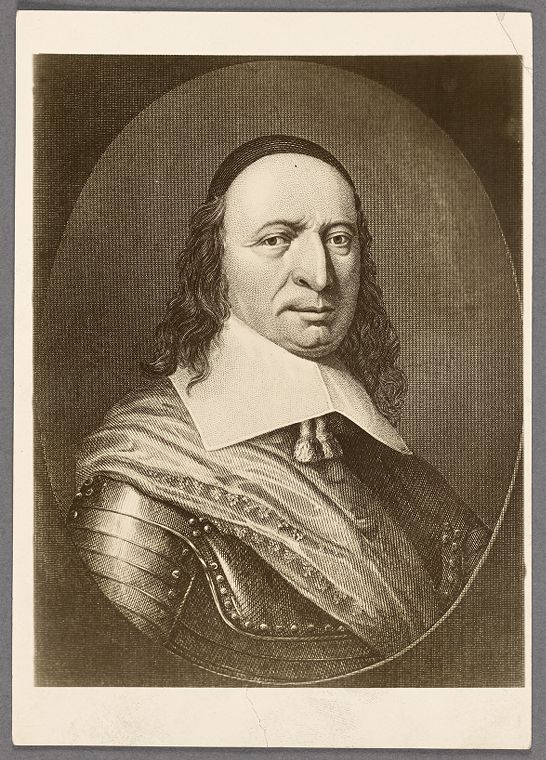
Peter Stuyvesant was appointed Director-General of New Netherland in 1647, inheriting a colony facing administrative, military, and financial challenges. While he strengthened defenses, expanded trade, and oversaw important public works, he ultimately would be the last Dutch administrator of the colony.
1647: Peter Stuyvesant Appointed Director-General
Peter Stuyvesant had previously served the Dutch West India Company in the Caribbean and lost a leg during a military action on the island of Saint Martin, thereafter wearing the wooden leg that became part of his legend. Appointed Director-General of New Netherland in 1647, he inherited a colony facing administrative, military, and financial challenges.
During his seventeen-year administration, Stuyvesant strengthened defenses, improved public administration, expanded trade, and oversaw important public works. Under his leadership, New Amsterdam grew substantially in population and economic importance. Yet his forceful style often brought him into conflict with settlers who demanded greater local autonomy and with religious groups seeking broader freedom of worship.
Stuyvesant’s administration thus embodied both the strengths and limitations of Dutch colonial rule: energetic government, commercial success, and growing prosperity alongside recurring disputes over authority and religious tolerance.
Sources
Wikipedia. "Peter Stuyvesant." https://en.wikipedia.org/wiki/Peter_Stuyvesant.
Museum of the City of New York. "Petrus Stuyvesant." https://www.mcny.org/petrus-stuyvesant.
Further Reading
Burrows, Edwin and Mike Wallace. Gotham: A History of New York City to 1898. Oxford University Press, 1998.
Merwick, Donna. Stuyvesant Bound: An Essay on Loss Across Time. The University of Pennsylvania Press, 2013.
Shorto, Russell. The Island at the Center of the World: The Epic Story of Dutch Manhattan and the Forgotten Colony that Shaped America. Vintage Books, 2004.
1654: Jewish Settlers Arrive in New Amsterdam
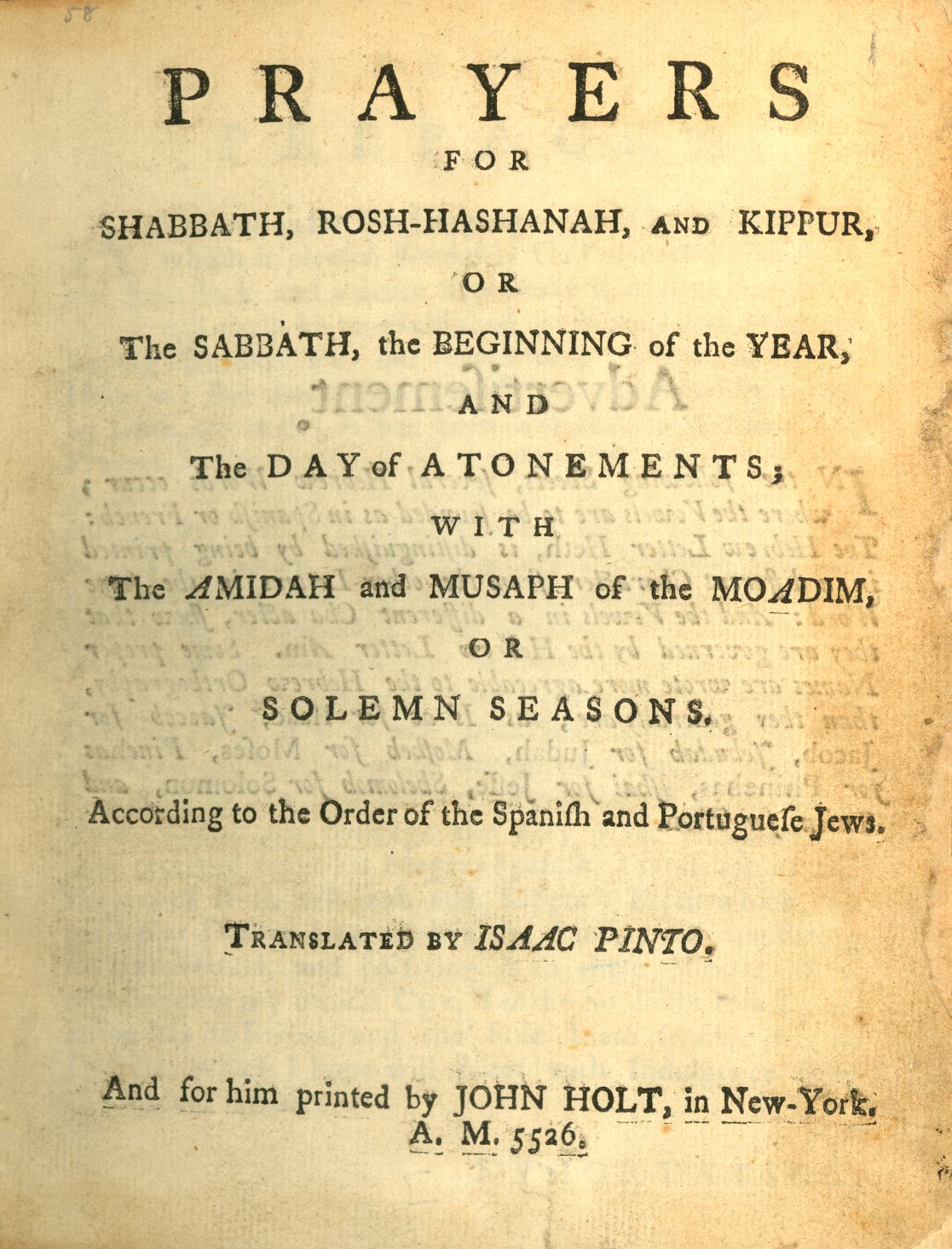
The first Jewish community of New Amsterdam was comprised of 23 refugee families, who came to the colony seeking safety from the Portuguese Inquisition. Though faced with discrimination from Stuyvesant and his government, they are a symbol of the colony's early prioritization of religious toleration and freedoms.
1654: Jewish Settlers Arrive in New Amsterdam
The first settlement of Jewish families arrived in New Amsterdam following the succumbing of the Dutch government’s brief hold of Brazil, and the return of Portuguese control of the colony. Facing persecution under the Portuguese Inquisition, 23 Jews sought out New Amsterdam, arriving in September of 1654.
Just weeks after their arrival, Director-General Peter Stuyvesant sought to expel the group from New Amsterdam, claiming that they would become a burden on the community and vehemently invoking anti-Semitic tropes to declare the developing colony unwelcome to Jewish settlers. This sentiment was not shared by the Dutch West India Company, however, who blocked Stuyvesant’s order and allowed the settlers to remain. The European Jewish community had long sought refuge in the Netherlands, where they had gained significant freedoms and rights under the Dutch policy of religious tolerance, and had in turn invested in the republic’s colonial endeavors. The authority in Amsterdam therefore granted leave to remain, under the condition that the Jewish community provide for themselves financially, and not rely on the colony for support.
Despite the approval of the West India Company, the social and economic position of these first families remained precarious. Extant documents record instances of individuals like Salvador Dandrada, Asser Levy, and Jacob Barsimson being blocked from buying property, engaging in trade, or being penalized for not complying with Christian doctrine. Nevertheless, there is evidence of an emerging policy of religious toleration and co-existence in the historical record, and the Jewish population of New Amsterdam continued to grow over the 1650s. They founded the Congregation Shearith Israel, and the remains of their community burial ground can be found in downtown Manhattan.
Like the Flushing Remonstrance, the presence of this early Jewish settlement provides a window into the active negotiation of the character of the New Netherlands, constituting an important episode in the process of defining its commitment to globality and toleration.
Sources
Howard, Ronald. “First Jewish Settlers in North America.” EBSCO Research Starter, 2022.
Wikipedia. “Jews in New Amsterdam.” https://en.wikipedia.org/wiki/Jews_in_New_Amsterdam.
Further Resources
Gurock, Jeffrey S., ed. The Colonial and National Periods, 1654-1820. Vol. 1 in American Jewish History. New York: Routledge, 1998.
Oppenheim, Samuel. The Early History of the Jews in New York, 1654-1664. New York: American Jewish Historical Society, 1909.
Phillipse Manor Hall Virtual Wing. “Jews in Colonial New York.” https://www.philipsemanorhall.com/blog/jews-in-colonial-new-york.
1657: The Flushing Remonstrance
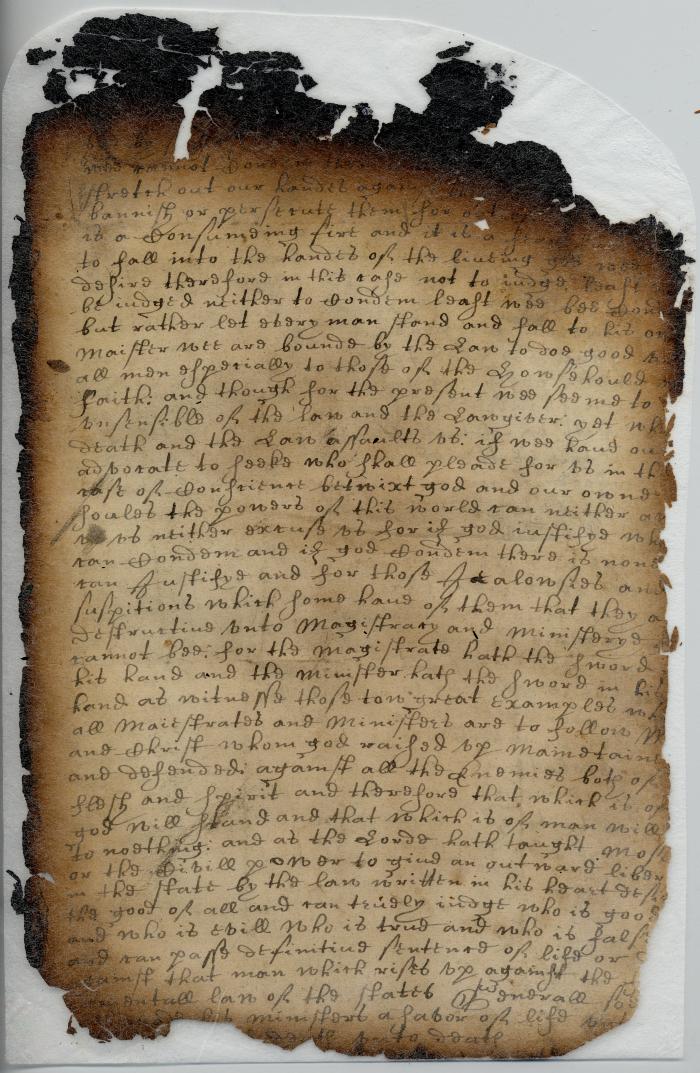
In 1657, residents of the town of Flushing presented a petition proclaiming their freedom to practice Quakerism in one of the most significant early expressions of religious liberty in America.
1657: The Flushing Remonstrance
In 1657, residents of the Long Island town of Flushing presented a petition known as the Flushing Remonstrance in response to Stuyvesant’s efforts to suppress Quaker worship. Drawing upon Dutch traditions and Christian principles, the petitioners argued that liberty of conscience should be extended to all people, regardless of religious affiliation.
The Remonstrance declared that the signers could not, in good conscience, deny others the freedom to worship according to their beliefs. Although the petition did not immediately alter colonial policy, it became one of the most celebrated statements of religious liberty in early American history and foreshadowed principles later embedded in the nation’s constitutional tradition.
Taken together, the admission of Jewish settlers and the Flushing Remonstrance demonstrate that New Netherland’s tradition of religious tolerance was becoming an important element of the colony’s civic identity. While imperfectly applied and often contested, tolerance helped distinguish New Netherland from many of its contemporaries and left a lasting imprint on New York’s development.
Sources
Historical Society of the New York Courts. "The Flushing Remonstrance, 1657." https://history.nycourts.gov/about_period/flushing-remonstrance/.
Wikipedia. "The Flushing Remonstrance." https://en.wikipedia.org/wiki/Flushing_Remonstrance.
Further Reading
Haefeli, Evan. New Netherland and the Dutch Origins of American Religious Liberty. University of Pennsylvania Press, 2016.
Shorto, Russell. The Island at the Center of the World: The Epic Story of Dutch Manhattan and the Forgotten Colony that Shaped America. Vintage Books, 2005.
1664: The English Arrive
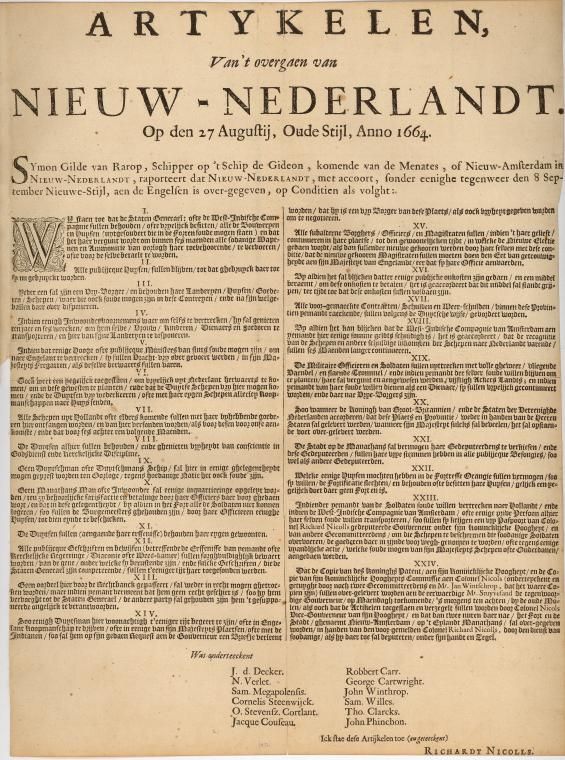
In 1664, an English fleet under the command of Admiral Richard Nicolls entered the New Amsterdam harbor and demanded Dutch surrender. The transfer of colonial control was bloodless, and New York was established.
1664: The English Arrive
The English conquest marked a turning point in New York’s history, but not a sharp break with its past. Unlike many colonial conquests, the transfer of New Amsterdam in 1664 occurred with remarkably little bloodshed, and many of the institutions, customs, and traditions established under Dutch rule survived long afterward.
In 1664, an English fleet entered New York Harbor and demanded the surrender of New Amsterdam. Governor Peter Stuyvesant initially favored resistance, but many of the colony’s merchants and civic leaders saw little advantage in fighting. Faced with overwhelming force and limited public support, Stuyvesant agreed to surrender. The transfer of New Amsterdam to English control was one of the most consequential bloodless handovers in colonial American history.
The transition was overseen by Colonel Richard Nicolls, the first English governor of New York. A trusted representative of the Duke of York and one of four royal commissioners sent to strengthen royal oversight in New England and monitor developments throughout the region, Nicolls managed the transfer with notable pragmatism.
The Articles of Capitulation negotiated between the Dutch and English guaranteed the protection of property rights, inheritance, existing contracts, and freedom of worship. Nicolls honored those commitments, preserving Dutch legal customs and permitting continued religious practice.
His policies reflected both practical politics and the realities of a colony already accustomed to ethnic and religious diversity. In this respect, English rule reinforced rather than erased one of New Netherland’s most enduring characteristics.
The colony was renamed New York in honor of the Duke of York, the future King James II. Yet Dutch culture remained deeply embedded in society. Dutch churches flourished, Dutch continued to be spoken throughout much of the Hudson Valley, and Dutch legal customs persisted for generations.
The English conquest therefore marked not the end of New Netherland’s legacy but its transformation. New York would become an English colony, yet it would remain profoundly influenced by Dutch traditions of commerce, local self-government, and religious tolerance.
Those traditions, combined with the colony’s strategic geography and longstanding relationships with Native nations, laid the foundations for the remarkable growth and influence New York would achieve during the eighteenth century.
Sources
Wikipedia. "Conquest of New Netherland." https://en.wikipedia.org/wiki/Conquest_of_New_Netherland#References.
Britannica. "Richard Nicolls." https://www.britannica.com/biography/Richard-Nicolls.
Further Reading
The Gilder Lehrman Institute of American History. "The surrender of New Netherland, 1664: A Spotlight on a Primary Source by Richard Nicholls." https://www.gilderlehrman.org/history-resources/spotlight-primary-source/surrender-new-netherland-1664.
Ritchie, Robert. The Duke’s Province: A Study of New York Politics and Society, 1664-1691. University of North Carolina Press, 2012.
Shorto, Russell. Taking Manhattan: The Extraordinary Events that Created New York and Shaped America. W.W. Norton & Co, 2025.
1683: Charter of Liberties and Privileges
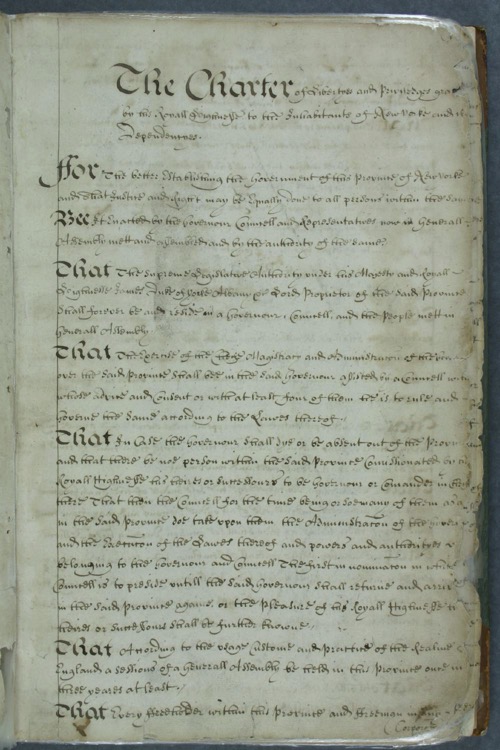
The Charter of Liberties and Privileges represents an early articulation of self-representation and governance by New Yorkers, setting the scene for later challenges to the British crown's authority over its colonies.
1683: Charter of Liberties and Privileges
In 1683, the first meeting of the New York General Assembly drafted a document which laid out principles for the governance of the colony and the rights and freedoms of the colonists. While still operating under the authority of the King and Parliament of England, the Charter identified the assembly of colonists as a significant part of their own governance and organized the population into twelve counties. This followed similar structures which emerged in colonies like Pennsylvania and New Jersey, reflecting a wider trend of settlers moving towards a more individuated sense of self.
James, in his position as Duke of York, initially approved the charter and the colony operated under its guidelines for three years. In 1686, however, after becoming King, he repealed his confirmation of the document, and instead assimilated the colony into the Dominion of New England, citing the weakening of colonial authority represented by the general assembly. The assembly was not called to gather again until after the events of the Glorious Revolution and Liesler’s Rebellion.
Though never an official colonial policy, the Charter of Liberties and Privileges represents a formative early articulation of settler’s desires for a more representative government, and their sense of themselves as a corporate body separate from England. While still almost a century remained before the colonial congresses of the Revolution, the New York General Assembly’s assertion of their suffrage and political authority constitute an important early challenge to the crown’s control of their overseas colonies.
Sources
Wikipedia. “Charter of Liberties and Privileges.” https://en.wikipedia.org/wiki/Charter_of_Liberties_and_Privileges.
Historical Society of the New York courts. “British Colonial Charters.” https://history.nycourts.gov/about_period/british-colonial-charters/.
New York State Archives. “Charter of Liberties and Privileges (1683).” https://history.nycourts.gov/wp-content/uploads/2019/01/Publications_Charter-Liberties-1683-compressed.pdf.
Further Resources
Phelan, Thomas. Thomas Dongan: Colonial Governor of New York 1683-1688. Kessinger Publishing, 2008.
1689: Liesler's Rebellion
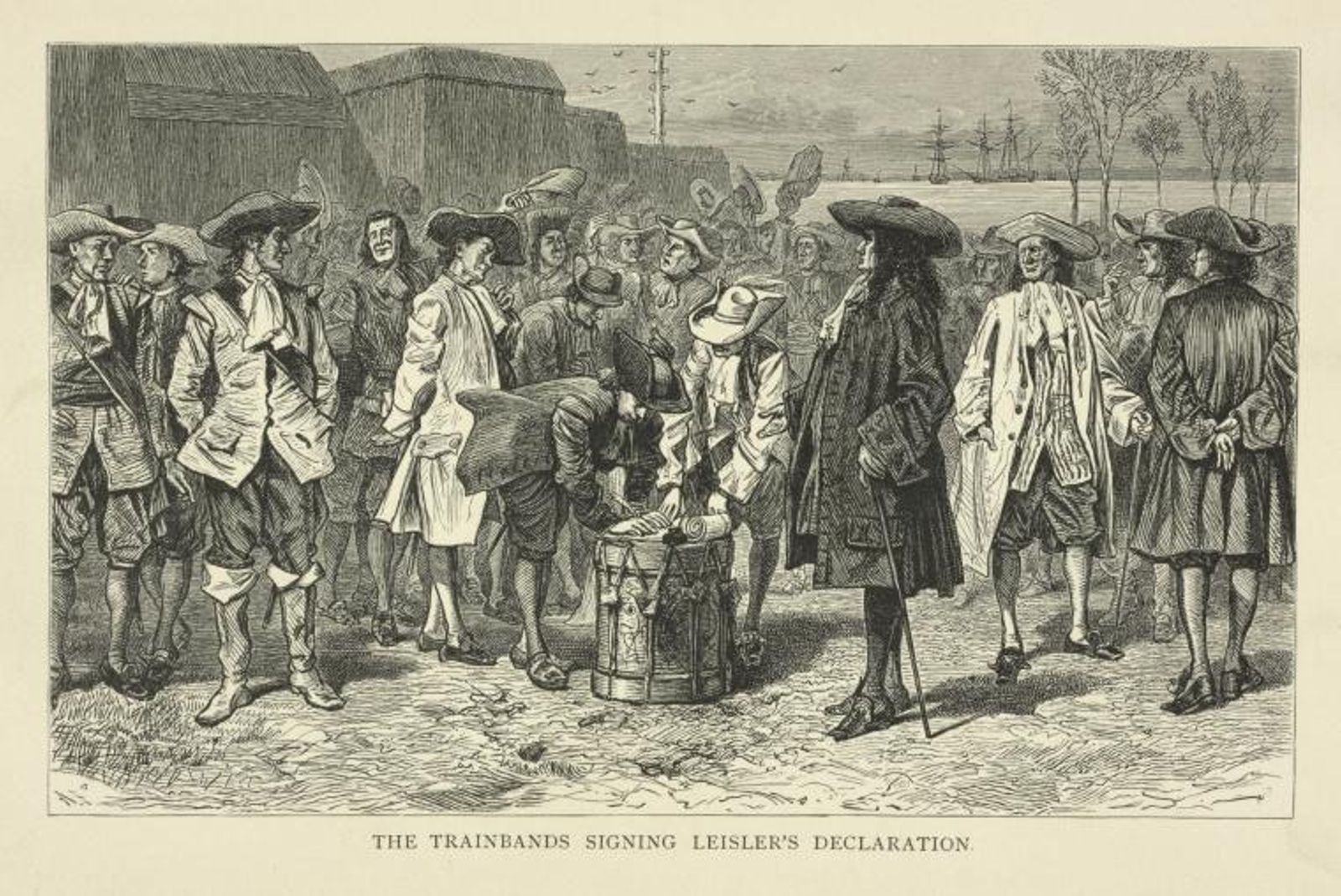
Amid the political and religious uncertainty of the Glorious Revolution of 1688, a merchant and militia leader Joseph Liesler seized control of New York City, claiming to defend the settler's Protestant liberties against colonial rule.
1689: Liesler's Rebellion
Like many British colonies, New York experienced recurring tensions between royal governors and elected assemblies. Questions of taxation, military expenditures, land policy, and political authority frequently generated conflict.
The colony’s most dramatic political crisis followed England’s Glorious Revolution of 1688. Amid uncertainty over political authority, merchant and militia leader Jacob Leisler seized control of New York in 1689.
To supporters, Leisler defended Protestant liberties and protected the colony against arbitrary government. To opponents, he represented dangerous political radicalism and unlawful rebellion. When royal authority was restored, Leisler was arrested, tried, and executed.
The controversy surrounding Leisler’s Rebellion divided New Yorkers for decades. More importantly, it revealed a growing willingness among colonists to participate directly in political affairs and foreshadowed later disputes over authority and representation.
By the eighteenth century, New Yorkers had developed a strong attachment to representative institutions. Elections, legislative debates, petitions, and public meetings became familiar features of political life. Although royal governors retained significant authority, they increasingly encountered colonists prepared to defend what they regarded as their traditional rights and privileges.
Sources
Wikipedia. "Liesler's Rebellion." https://en.wikipedia.org/wiki/Leisler%27s_Rebellion.
Further Reading
Bliss, Robert. Revolution and Empire: English Politics and the American Colonies in the Seventeenth Century. Manchester: Manchester University Press, 1990.
Jacob Leisler Papers Collection, Jacob Leisler Institute, Hudson, NY. https://jacobleislerinstitute.org/.
Lovejoy, David. The Glorious Revolution in America. Wesleyan University Press, 1987.
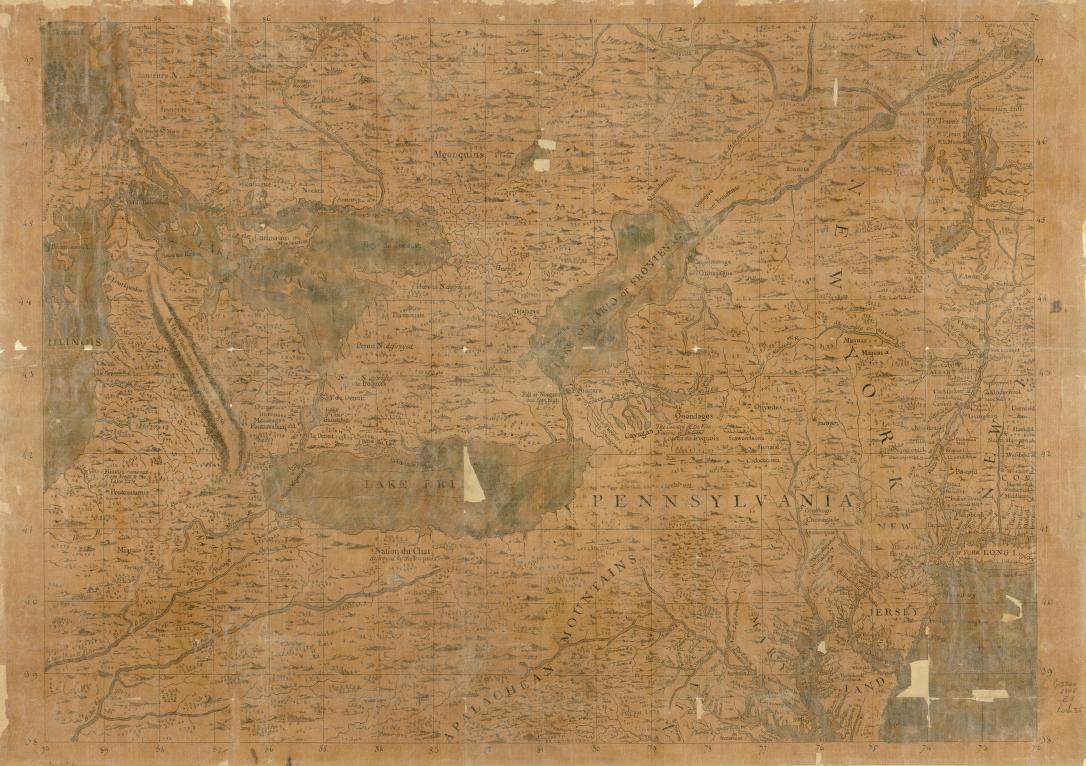
1702-1713: Queen Anne's War
The American theater of the War of Spanish Succession, Queen Anne's War put New York on the front lines, with military expeditions moving through the Hudson and Champlain corridors.
1702-1713: Queen Anne's War
Throughout the colonial era, New York stood at the center of the struggle among European empires for control of North America. Its strategic position between New France and the British colonies, combined with its relationships with the Haudenosaunee Confederacy, ensured that military conflict repeatedly touched the colony.
During King William’s War (1689–1697), the North American phase of the War of the League of Augsburg, frontier communities faced raids and disruption as Britain and France competed for influence. The conflict revealed the vulnerability of New York’s northern frontier and underscored the importance of alliances with Native nations.
Queen Anne’s War (1702–1713), the American theater of the War of the Spanish Succession, again placed New York on the front lines. Military expeditions moved through the Hudson and Champlain corridors, while colonial leaders worked to preserve the alliance with the Haudenosaunee Confederacy. The war reinforced Albany’s importance as both a military and diplomatic center.
Sources
Wikipedia. "King William's War." https://en.wikipedia.org/wiki/King_William%27s_War.
Wikipedia. "Queen Anne's War." https://en.wikipedia.org/wiki/Queen_Anne%27s_War.
Waller, George M. "New York's Role in Queen Anne's War, 1702–1713." New York History 33.1 (1952): 40–53.
Further Reading
Chet, Guy. Conquering the American Wilderness: The Triumph of European Warfare in the Colonial Northeast. University of Massachusetts Press, 2003.
Laramie, Michael. Queen Anne's War: The Second Contest for North America, 1702-1713. Westholme Publishing, 2021.
Marquis, Samuel. Empire and Frontier: Colonel Peter Schuyler and the Valiant Iroquois in King William's War, 1689-1701. Pegasus Books, 2026.
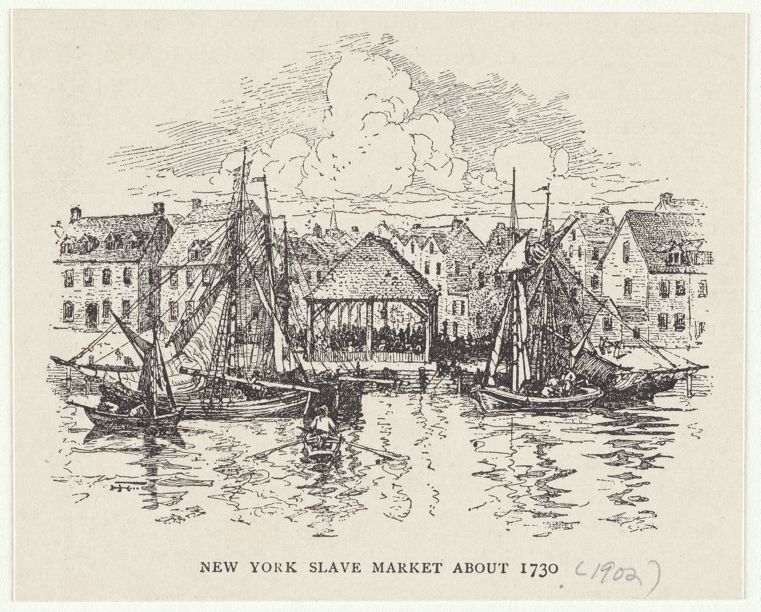
1712: the Slave Revolt Erupts
In 1712, a group of enslaved men and women in New York City formed a plan to revolt against their oppressors and the increasingly restrictive laws they were subject to. They ultimately failed, and were harshly punished in the aftermath of the violence.
1712: the Slave Revolt Erupts
In April of 1712, twenty-three enslaved people initiated a revolt against the white enslaver population of New York City. They started a fire as a diversion, then attacked the responding crowd with guns and hatchets, killing eight and wounding seven. In retaliation, seventy black people were arrested, twenty-seven put on trial and twenty-one executed.
Over the course of the early 18th century, the rights of both free and enslaved black people in New York were gradually constricted, changing the rights granted by the Dutch colonial authority. New York had one of the largest enslaved populations of any English colony, with the white, free, and enslaved communities living in close and intimate proximity. Under Dutch control, there was more freedom of movement and opportunities for land ownership and eventual manumission, however, the English colonial government imposed increasingly restrictive laws on the black population. The slave trade’s centrality to the city’s economy grew as well, with the first market established in late 1711, just five months before the attempted revolt.
Of the seventy men and women arrested in the aftermath of the uprising, six committed suicide, twenty-seven put on trial, and twenty-one, including one pregnant woman, put to death by public burning or hanging. Restrictions on the black community intensified further, and the Governor of New York imposed a tax of £200 on each person freed from 1715 onwards. The swift retaliation by white slave-holding New Yorkers failed to successfully quell resistance, and the city experienced another uprising of black and impoverished white residents in the Conspiracy of 1741.
Sources
Smithsonian Magazine. “The New York Slave Revolt of 1712 Was a Bloody Prelude to Decades of Hardship.” https://www.smithsonianmag.com/smart-news/new-york-slave-revolt-1712-was-bloody-prelude-decades-hardship-180958665/.
Wikipedia. “New York Slave Revolt of 1712.” https://en.wikipedia.org/wiki/New_York_Slave_Revolt_of_1712.
Wikipedia. “New York Conspiracy of 1741.” https://en.wikipedia.org/wiki/New_York_Conspiracy_of_1741.
Further Resources
Hughes, Ben. When I Die I Shall Return to My Own Land: The New York Slave Revolt of 1712. Westholme Publishing, 2021.
Hughes, Ben. The New York City Slave Revolt of 1712: The First Enslaved Insurrection in British North America. Westholme Publishing, 2024.
Foote, Thelma Wills. Black and White Manhattan: The History of Racial Formation in Colonial New York City. New York: Oxford University Press, 2004.
Lepore, Jill. New York Burning: Liberty, Slavery and Conspiracy in Eighteenth-Century Manhattan. New York: Alfred A. Knopf, 2005.
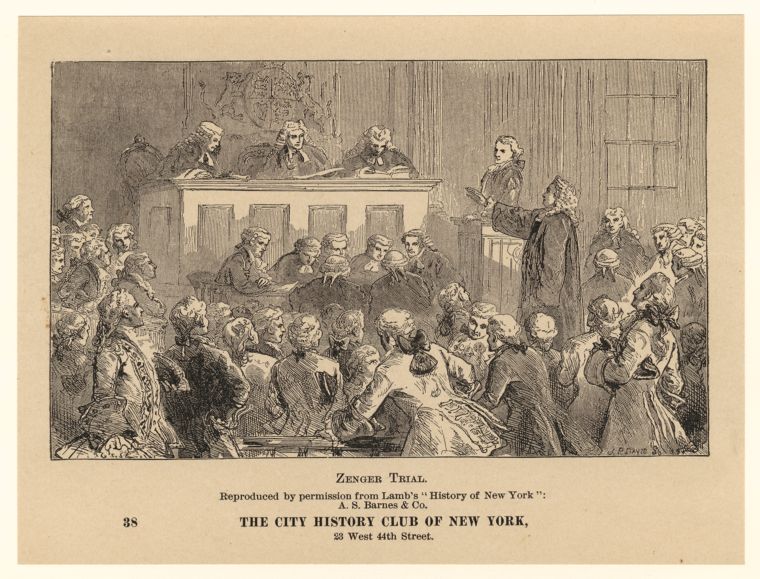
1735: the Trial of John Peter Zenger
In 1735, printer John Peter Zenger was tried for publishing criticisms of the royal governor in a case which established a precedence for the American tradition of freedom of expression.
1735: the Trial of John Peter Zenger
By the eighteenth century, New York had become more than a center of trade and diplomacy. It was also emerging as one of the foremost intellectual and cultural capitals of British North America. Newspapers circulated widely, books and pamphlets arrived from Europe and other colonies, and coffeehouses, taverns, and churches became places where public affairs were debated with increasing vigor.
As commerce expanded, so too did literacy and public engagement. Merchants, lawyers, clergy, and artisans participated in a growing culture of discussion that connected New York to the wider Atlantic world. Ideas about government, liberty, religion, commerce, and science moved through the colony alongside goods and people.
One of the most celebrated episodes in colonial New York occurred in 1735, when printer John Peter Zenger was tried for publishing criticisms of the royal governor. The case arose from political disputes within the colony, but its implications extended far beyond New York.
Although the legal principles involved were still evolving, Zenger’s acquittal became an enduring symbol of the importance of a free press and the right to challenge governmental authority. The trial helped establish New York as a center of political discussion and public debate and later assumed an honored place in the American tradition of freedom of expression.
Sources
Historical Society of the New York Court. "Crown v. John Peter Zenger, 1735." https://history.nycourts.gov/case/crown-v-zenger/.
Wikipedia. "John Peter Zenger." https://en.wikipedia.org/wiki/John_Peter_Zenger.
Further Reading
Eldridge, Larry D. "Before Zenger: Truth and Seditious Speech in Colonial America, 1607–1700." American Journal of Legal History (1995): 337-358.
Olsen, Alison (2000). "The Zenger Case Revisited: Satire, Sedition and Political Debate in Eighteenth Century America". Early American Literature. 35 (3). University of Maryland: 223–245.
Pasley, Jeffrey L. "The tyranny of printers": newspaper politics in the early American republic. Charlottesville; London : University Press of Virginia, 2003.
Smith, Jeffrey. Printers and Press Freedom: The Ideology of Early American Journalism. Oxford University Press, 1990.
Zenger, John Peter. "The New-York weekly journal." New York Public Library, New York. https://www.nypl.org/research/research-catalog/bib/b21451507.
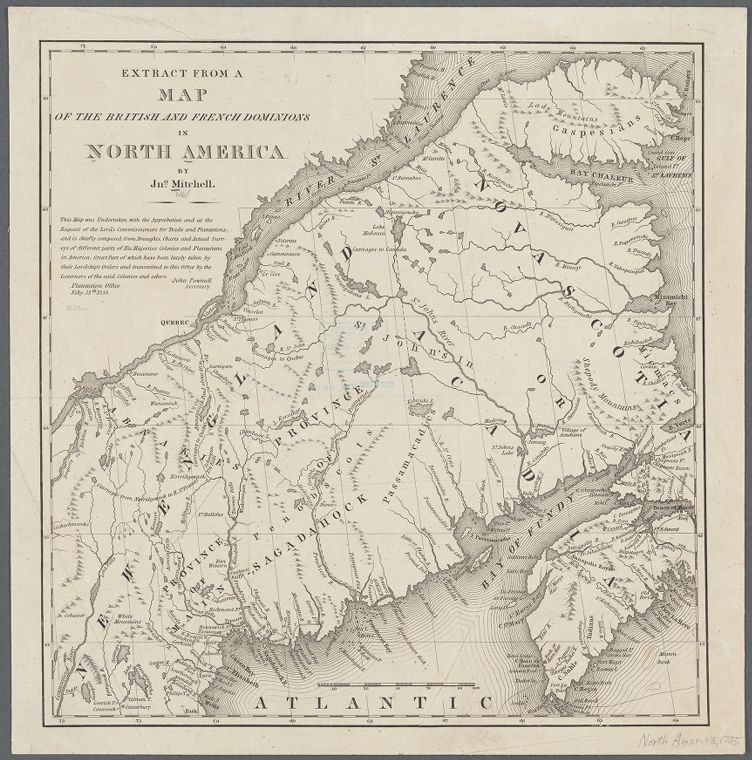
1754-1763: The French and Indian War
Fought between the British and French colonial powers and their indigenous allies, the French and Indian War was crucial in deciding the future balance of power on the continent, and contributed directly to the tensions that would culminate in the American Revolution.
1754-1763: The French and Indian War
Imperial rivalry reached its climax during the French and Indian War (1754–1763), the North American phase of the global Seven Years’ War. Major campaigns were fought along Lake George and Lake Champlain, at Fort William Henry, Crown Point, and Ticonderoga, and throughout the northern frontier. More than any other colony, New York became the principal battleground between Britain and France, would determine the future balance of power on the continent.
These wars shaped New York’s economy, politics, and society. They strengthened military institutions, deepened relationships with Native allies, and highlighted the strategic significance of the Hudson–Mohawk corridor. At the same time, the financial burdens imposed by Britain’s victory in 1763 contributed directly to the imperial tensions that would culminate in the American Revolution.
Sources
U.S. Department of State Office of the Historian. "French and Indian War/Seven Years' War, 1754-63." https://history.state.gov/milestones/1750-1775/french-indian-war.
Wikipedia. "French and Indian War." https://en.wikipedia.org/wiki/French_and_Indian_War.
Fort Ticonderoga. https://fortticonderoga.org/.
Further Reading
Anderson, Fred. Crucible of War: The Seven Years’ War and the Fate of Empire in British North America, 1754-1766. New York: Random House, 2000.
Marston, Daniel. The French-Indian War, 1754-1769. Oxford, England: Osprey, 2002.
Schwartz, Seymoor. The French and Indian War, 1754-1763: The Imperial Struggle for North America. New York: Simon & Schuster, 1994.
1754: The Albany Congress
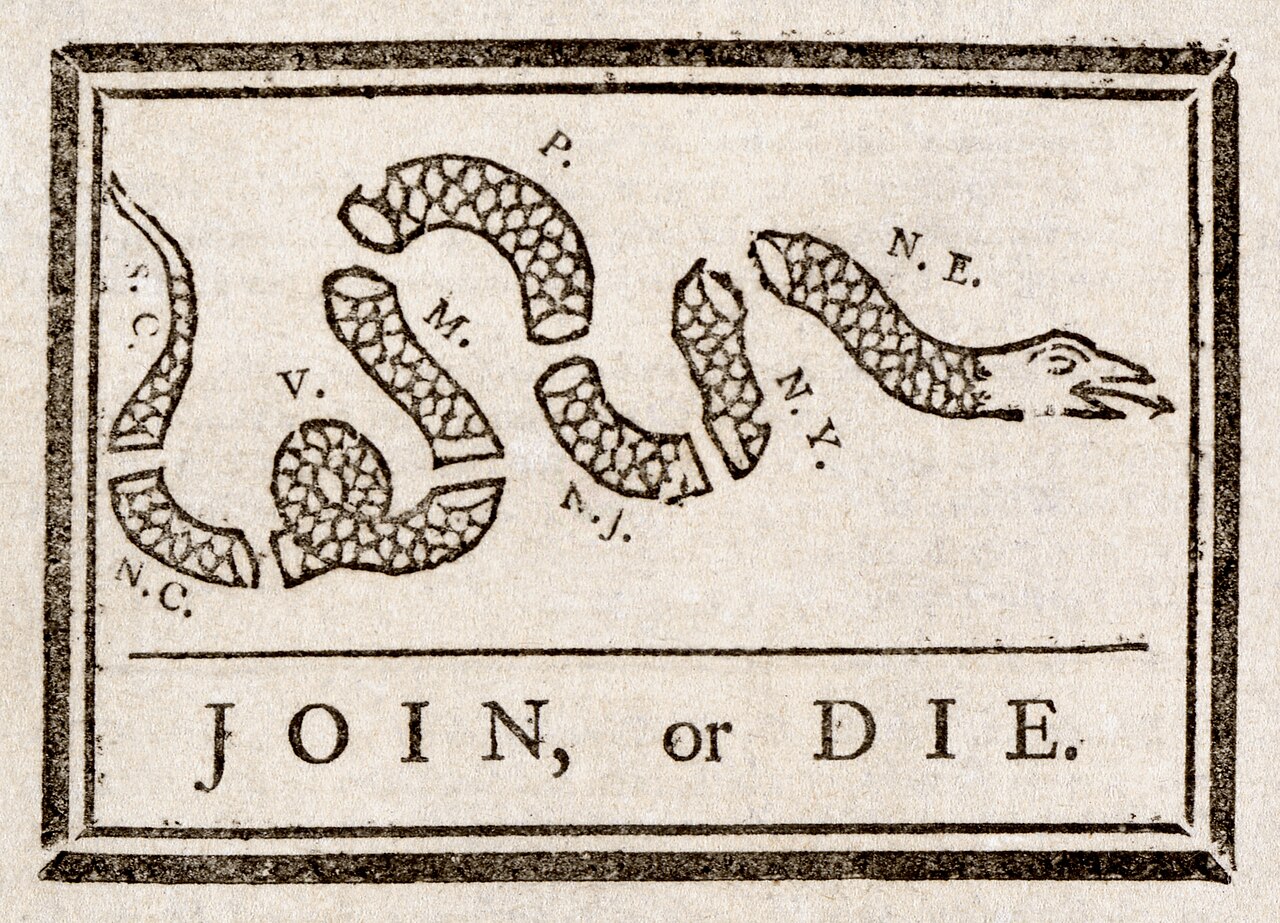
In 1754, cross-colony representatives gathered in Albany for a diplomatic congress with the Haudenosaunee Confederacy in an early show of colonial unity and recognition of the influence indigenous nations retained in the colonial space.
1754: The Albany Congress
Throughout the colonial period, Albany occupied a unique position at the intersection of Native diplomacy, imperial rivalry, and colonial politics. No other community in British North America played a more important role in maintaining relations between colonial governments and the Haudenosaunee Confederacy.
For colonial officials, diplomacy with the Haudenosaunee was not a peripheral concern but a central element of imperial strategy. Alliances with the Confederacy helped shape the balance of power among Britain, France, and Native nations throughout northeastern North America.
In 1754, representatives from seven British colonies gathered in Albany to discuss common defense and relations with the Haudenosaunee Confederacy. The Albany Congress reflected both New York’s strategic importance and the continuing influence of the Confederacy in imperial affairs.
Among the delegates was Benjamin Franklin, who proposed the Albany Plan of Union, one of the earliest schemes for coordinated colonial government. Although the plan was never adopted, it foreshadowed later efforts at intercolonial cooperation and ultimately the movement toward American union.
The Congress also underscored a larger reality: throughout much of the colonial period, Native nations were not simply subjects of European diplomacy but also active participants in it. The Haudenosaunee Confederacy exercised significant influence over relations among Britain, France, and the colonies and remained one of the most important political forces in northeastern North America.
Sources
Wikipedia. "Albany Congress." https://en.wikipedia.org/wiki/Albany_Congress.
Office of the Historian, US Department of State. "Albany Plan of Union, 1754." https://history.state.gov/milestones/1750-1775/albany-plan.
National Archives. "Proceedings of the Albany Congress, 19 June 1754 - 11 July 1754." https://founders.archives.gov/documents/Franklin/01-05-02-0096.
Further Reading
Shannon, Timothy. Indians and Colonists at the Crossroads of Empire: The Albany Congress of 1754. Cornell University Press, 2000.
White, Richard. The Middle Ground: Indians, Empires, and Republics in the Great Lakes Region, 1650-1815. Cambridge University Press, 1991.
1755: The Battle of Lake George
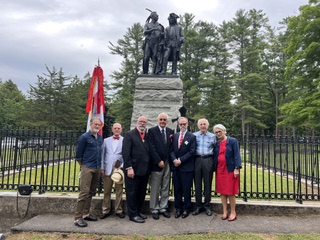
The Battle of Lake George represented an important victory of the British and Haudenosaunee alliance, and provides the foundation for our Society's Broken Arrow Ceremony.
1755: The Battle of Lake George
No individual was more influential in frontier affairs than Sir William Johnson, who settled in the Mohawk Valley and became Britain’s Superintendent of Indian Affairs for the Northern Department. Through diplomacy, trade, and personal relationships, Johnson cultivated close ties with the Haudenosaunee Confederacy and became one of the most powerful figures in colonial New York.
Among Johnson’s most important allies was the Mohawk leader Hendrick Theyanoguin, known to the British as King Hendrick. A respected diplomat and warrior, Hendrick played a central role in relations between the Confederacy and the British during the mid-eighteenth century.
A monument overlooking Lake George, erected in 1904 by the Society of Colonial Wars in the State of New York, commemorates their partnership. The sculpture depicts Johnson and Hendrick discussing strategy before the Battle of Lake George in 1755. According to a well-known tradition, Johnson proposed dividing his forces, whereupon Hendrick broke a single arrow and then demonstrated that several arrows bound together could not easily be broken. The lesson was clear: unity was strength.
Whether literally true or refined through retelling, the story captures an essential reality of colonial New York: British success on the frontier depended heavily upon Native allies whose experience and judgment commanded respect.
Sources
Wikipedia. "The Battle of Lake George." https://en.wikipedia.org/wiki/Battle_of_Lake_George.
American Revolutionary Geographies Online. "Planting the Seeds of Rebellion: The Battle of Lake Geroge, September 8, 1755." https://www.argomaps.org/stories/lake-george/.
Britannica. "Sir William Johnson, 1st Baronet." https://www.britannica.com/biography/Sir-William-Johnson-1st-Baronet.
Wikipedia. "Hendrick Theyanoguin." https://en.wikipedia.org/wiki/Hendrick_Theyanoguin.
Further Reading
Carson, James Taylor. "Inventing a Past: Molly Brant's Life in Leadership." History Now 59 (2021): https://www.gilderlehrman.org/history-resources/essays/inventing-past-molly-brant%E2%80%99s-life-leadership.
Flexner, James Thomas. Mohawk Baronet: A Biography of Sir William Johnson. Syracuse University Press, 1990.
Griffith, William. "The Battle of Lake George: England's First Triumph in the French and Indian War." The History Press, 2016.
Hinderaker, Eric. "The Two Hendricks: Unraveling a Mohawk Mystery." Harvard University Press, 2011.
University of the State of New York, ed. The Papers of Sir William Johnson. Hutson Street Press, 2025.
1765: The Stamp Act and Riots
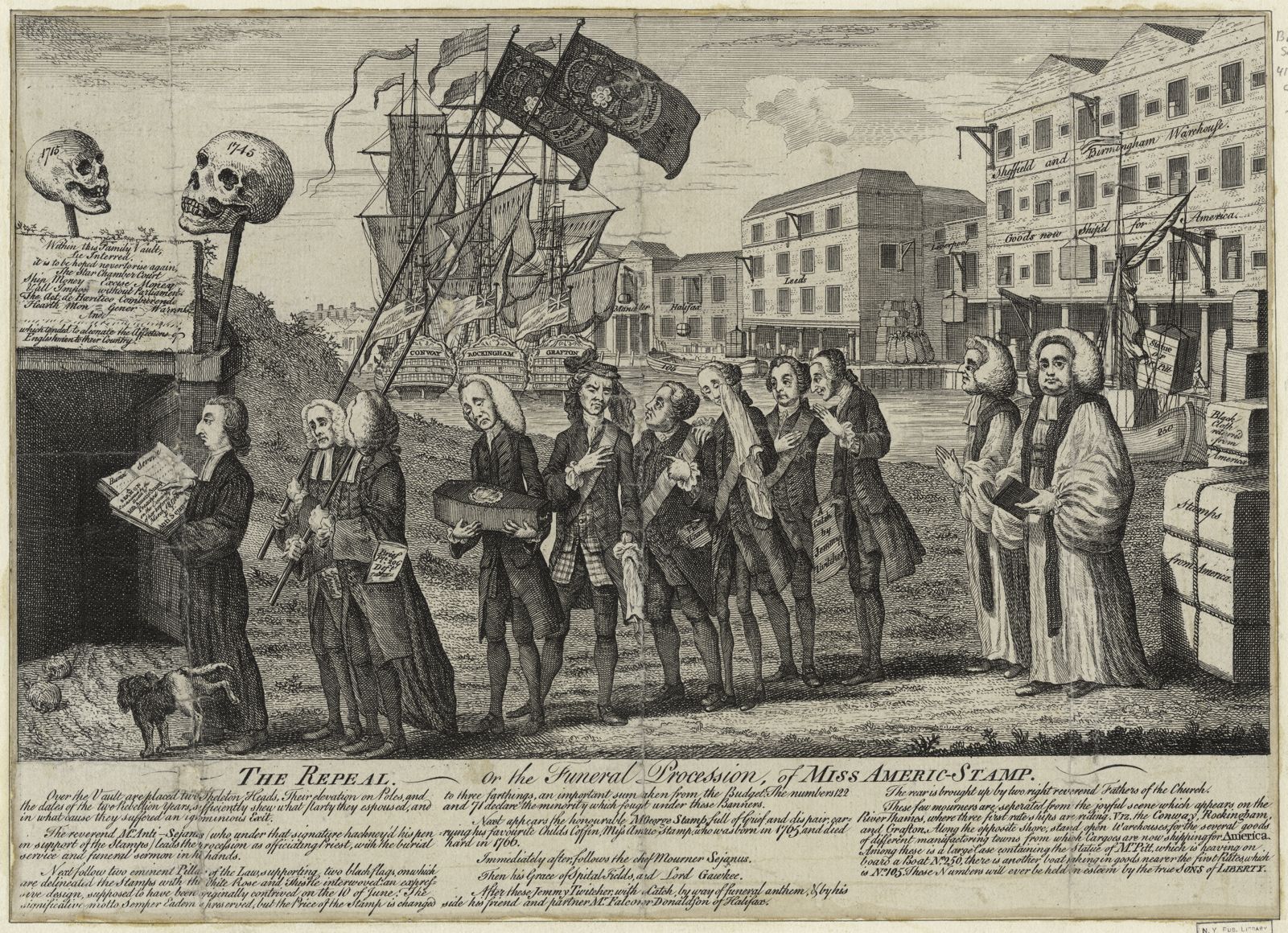
The Stamp Act of 1765 prompted a wave of colonial opposition, with public protests culminating in a coordinated response from representatives across the 13 colonies and setting the stage for revolutionary action.
1765: The Stamp Act and Riots
Britain’s victory in the French and Indian War transformed the political landscape of North America. France no longer threatened New York’s northern frontier, but the war left Britain heavily indebted. Seeking revenue to support imperial administration and defense, Parliament enacted a series of new taxes and regulations that many colonists regarded as violations of their rights.
Because New York was both a major commercial center and an important military post, these controversies were felt especially strongly within the colony. Merchants objected to restrictions on trade, while many colonists argued that taxes imposed without colonial consent violated the traditional rights of Englishmen.
The Stamp Act of 1765 produced particularly intense opposition. Public protests erupted in New York City and elsewhere. Merchants organized boycotts, crowds demonstrated against imperial policies, and groups such as the Sons of Liberty emerged as powerful forces in colonial politics.
New York played a central role in the colonial response. The Stamp Act Congress met in the city in 1765, bringing together representatives from several colonies to coordinate opposition. Like the Albany Congress a decade earlier, the gathering demonstrated the growing willingness of colonists to think and act collectively.
The controversy surrounding the Stamp Act represented more than opposition to a single tax. It reflected deeper questions that had been developing for generations: Who possessed legitimate political authority? What rights did colonists enjoy? How should power be divided between local assemblies and imperial institutions?
These debates increasingly occupied the attention of New Yorkers from every level of society.
Sources
Wikipedia. "Stamp Act Congress." Last edited September 20, 2026. https://en.wikipedia.org/wiki/Stamp_Act_Congress
The Gilder Lehrman Institute of American History. "The Stamp Act, 1765: A Spotlight on a Primary Source by George III." https://www.gilderlehrman.org/history-resources/spotlight-primary-source/stamp-act-1765.
Further Reading
Morgan, Edmund and Helen Morgan. The Stamp Act Crisis: Prologue to Revolution. UNC Press, 1995.
Hutchins, McLeod Zachary, ed. Community without Consent: New Perspectives on the Stamp Act. Dartmouth College Press, 2016.
Journal of the First Congress of the American colonies in opposition to the tyrannical acts of the British Parliament held at New-York, October 7, 1765. New York: 1765. https://borrow.nypl.org/search/card?id=ee7e7fb4-2356-5307-b207-fde8a5790155&entityType=FormatGroup.