
Colonial New York: From New Amsterdam to Revolution, 1624–1775
Introduction
No colony in British North America occupied a more strategic position than New York. Situated between New England and the Chesapeake, linked to the continent’s interior by the Hudson and Mohawk rivers, and connected to the Atlantic world through one of the finest natural harbors on the continent, New York became a crossroads of commerce, cultures, faiths, and empires.
From its origins as the Dutch colony of New Netherland to its emergence as one of Britain’s most prosperous and influential colonies, New York developed a character unlike any other in North America. Commerce drove its economy, diversity shaped its society, and diplomacy often determined its fate. While New York City served as the colony’s commercial heart, Albany and the Hudson–Mohawk corridor formed its strategic spine, linking the Atlantic world to the interior and making New York a center of trade, diplomacy, and military power.
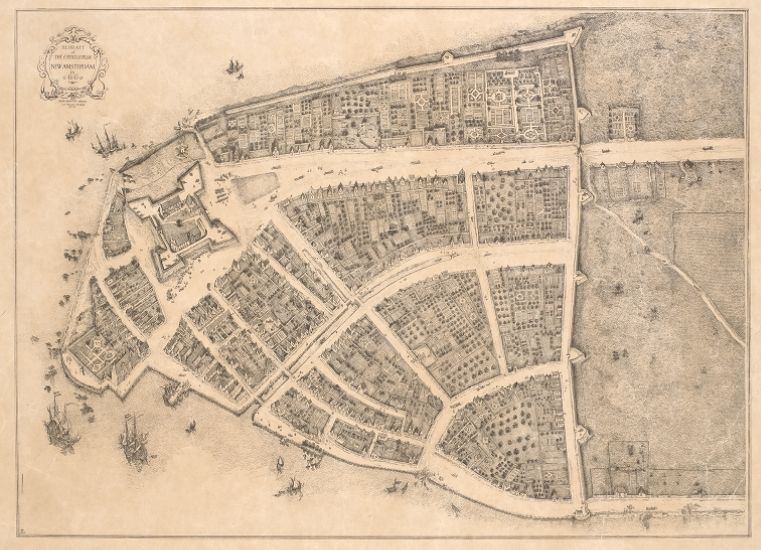
Equally distinctive was the colony’s tradition of religious tolerance. While never complete and often contested, the relative openness of Dutch society encouraged the settlement of people whose beliefs might have encountered greater restrictions elsewhere. This spirit of tolerance survived the English conquest and contributed to the remarkable religious diversity that characterized colonial New York. By the eighteenth century, Dutch Reformed congregations worshiped alongside Anglicans, Presbyterians, Lutherans, Quakers, Baptists, Huguenots, and one of the oldest Jewish communities in North America.
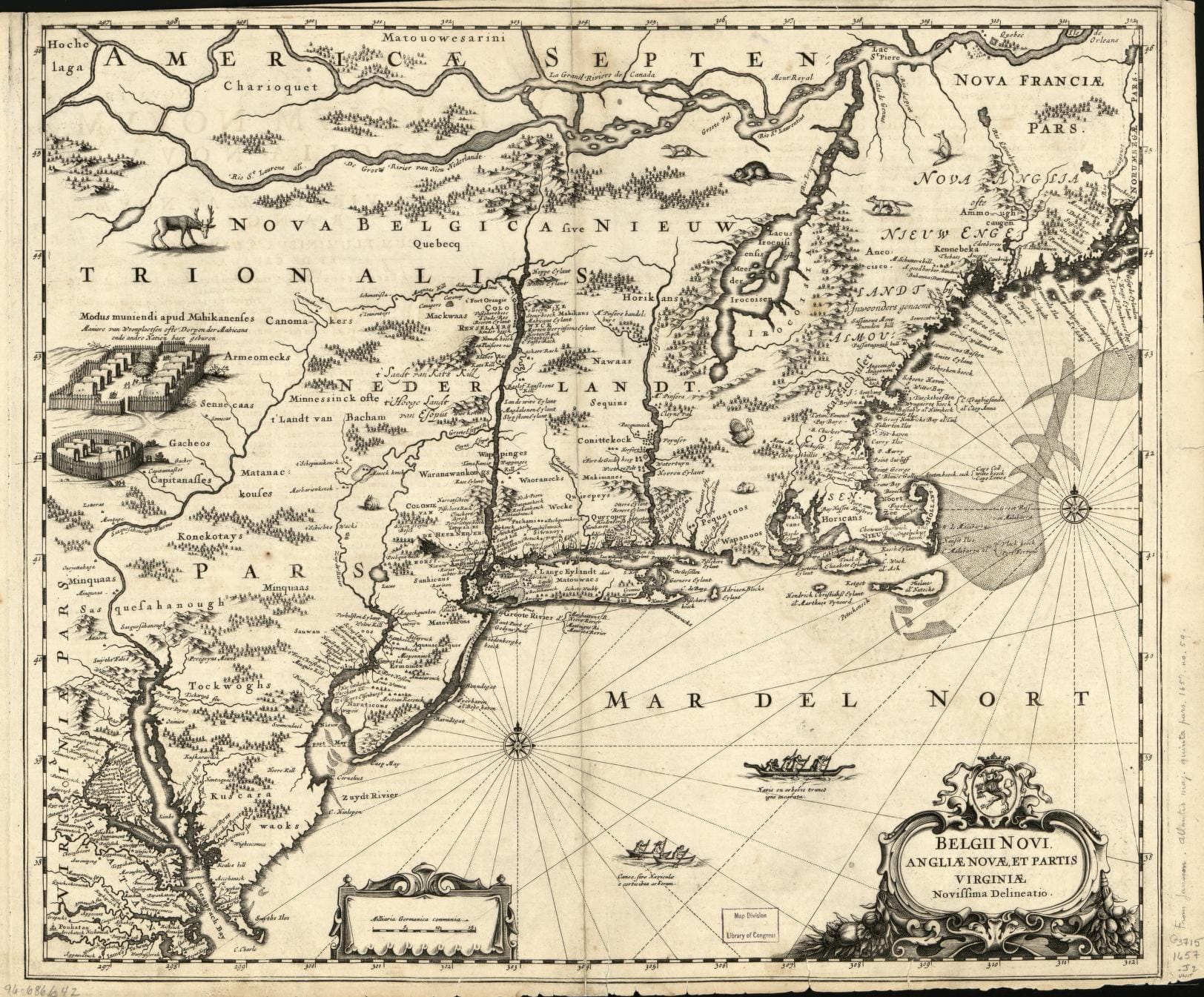
The story of colonial New York extends far beyond Manhattan. It encompasses New Amsterdam and New York City, but also Albany and the upper Hudson, Kingston and the Hudson Valley, Long Island, the Mohawk Valley, the northern frontier, and the lands of the Haudenosaunee (Iroquois) Confederacy. It is a history shaped not only by European settlers but also by Native nations whose diplomatic and military power profoundly influenced the colony’s development.
By the eve of the American Revolution, New York had become one of the most populous, prosperous, diverse, and strategically important colonies in British America. Understanding how it reached that position is essential to understanding both New York and the American experience.
New Netherland: Commerce and Opportunity
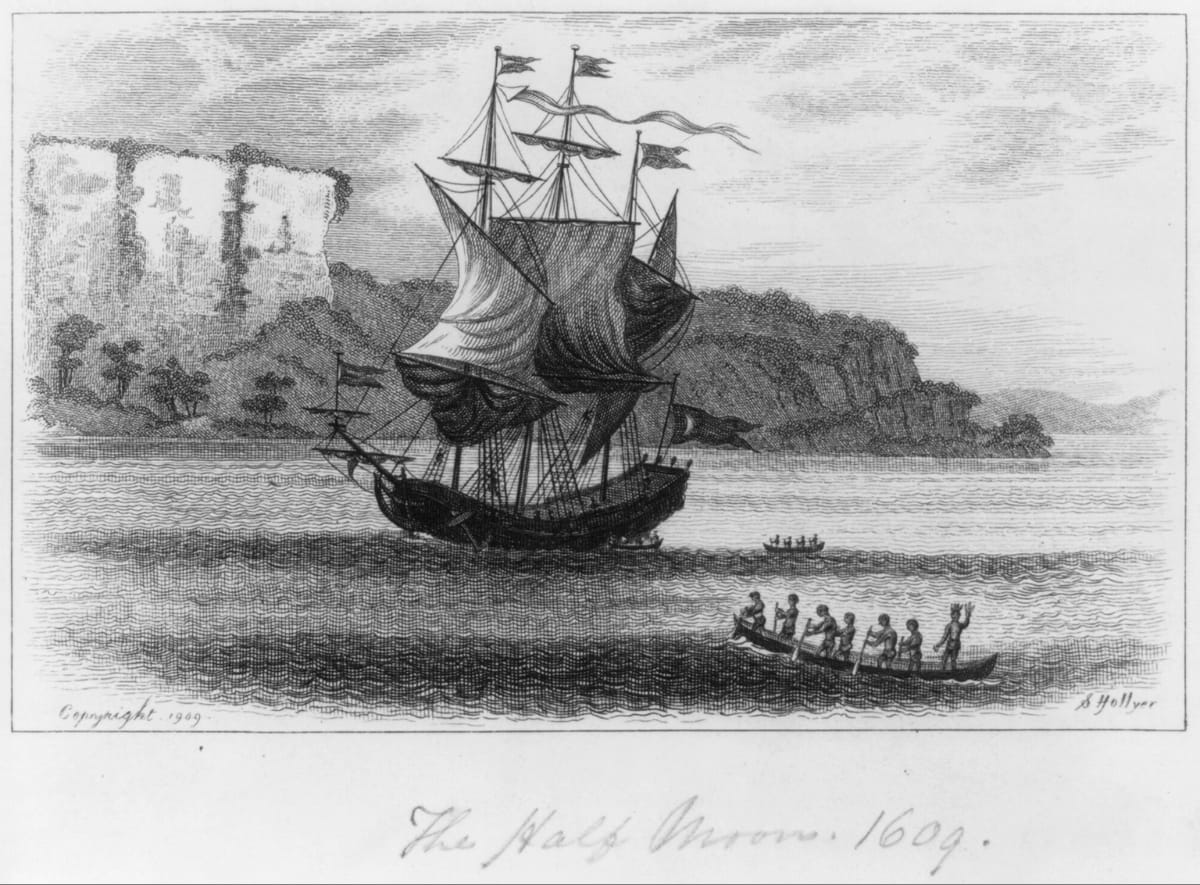
The origins of colonial New York lie in the Dutch Republic’s search for commercial opportunity during the seventeenth century. In 1609, the English navigator Henry Hudson, sailing on behalf of the Dutch East India Company, explored the river that now bears his name. Although he failed to discover the long-sought passage to Asia, his voyage revealed a region rich in natural resources and ideally situated for trade.
To capitalize on these opportunities, the Dutch West India Company established the colony of New Netherland in 1624. Settlements soon appeared at Fort Orange, near present-day Albany, and at several points along the Hudson River. The colony’s capital, New Amsterdam, occupied the southern tip of Manhattan Island, where a deep natural harbor offered extraordinary advantages for shipping and commerce.
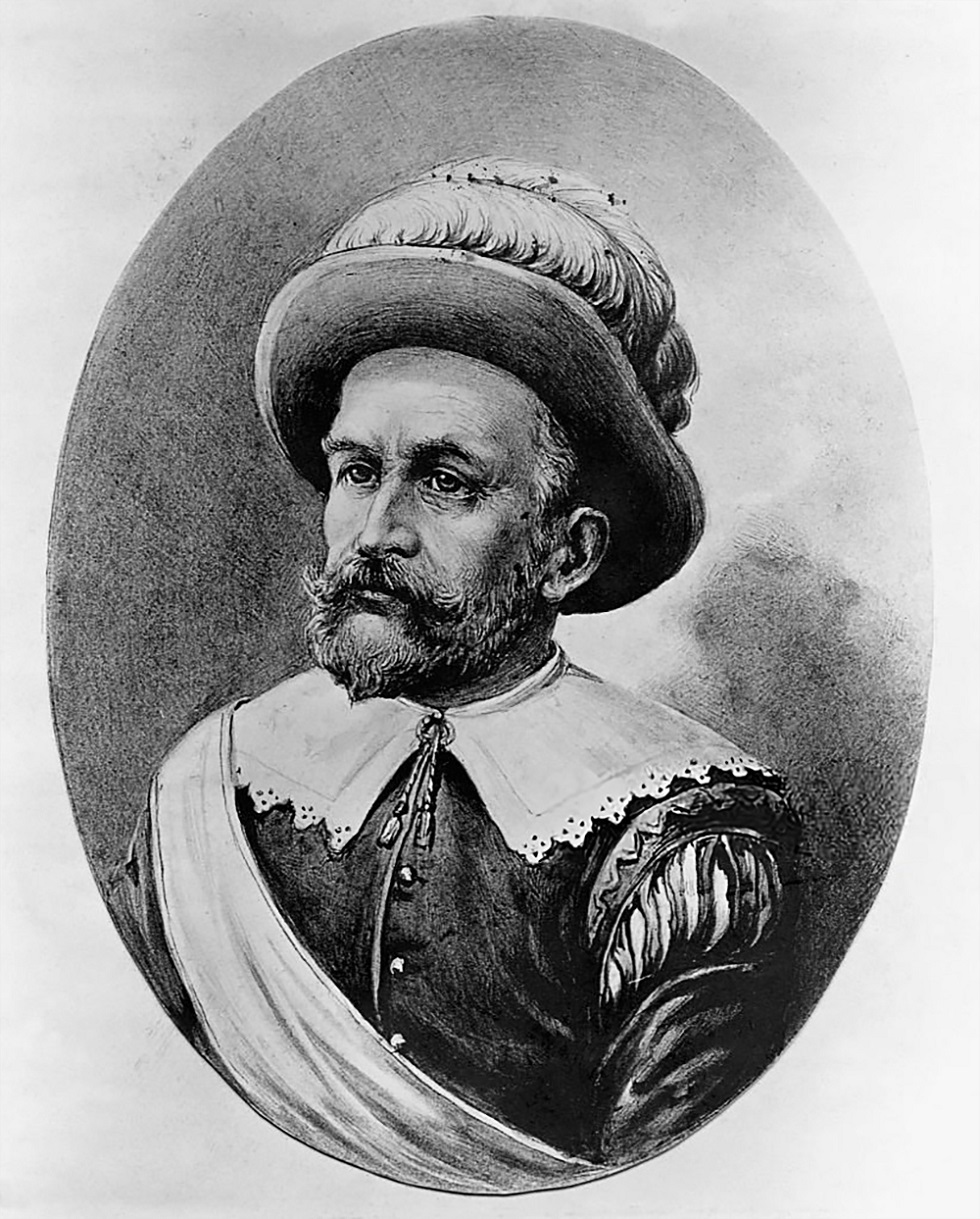
Among the colony’s most important figures was Peter Minuit, traditionally associated with the purchase of Manhattan in 1626. Whether the transaction occurred exactly as later generations imagined, Minuit became a symbol of the colony’s commercial outlook and its reliance upon negotiation, exchange, and diplomacy.
Born in the German city of Wesel and raised in a family of Walloon background, Minuit brought extensive commercial experience to New Netherland. Appointed director of the colony in 1626, he sought to strengthen Dutch claims to the region while encouraging settlement and trade. His administration helped establish Manhattan as the colony’s commercial center and laid foundations for New Amsterdam’s future growth.
Unlike many English colonies founded for religious purposes, New Netherland was established as a commercial enterprise. Trade shaped its development from the beginning. Merchants, sailors, artisans, and farmers arrived from across Europe, creating one of the most diverse populations in colonial North America.
Another of the colony’s most important figures was Adriaen van der Donck, a lawyer, scholar, and landowner whose writings provide invaluable descriptions of seventeenth-century New Netherland. Educated at the University of Leiden, one of Europe’s leading centers of learning, Van der Donck brought to the colony a broad understanding of law, politics, and humanist thought. Settling near present-day Yonkers, he became one of New Netherland’s largest landowners and one of its most articulate spokesmen.
Van der Donck emerged as a leading critic of Director-General Peter Stuyvesant and helped organize opposition to what many settlers regarded as an overly centralized and authoritarian government. Acting on behalf of colonists, he traveled to the Dutch Republic to present petitions calling for reforms, greater local participation in government, and stronger protections for settlers’ rights. His influential Description of New Netherland promoted the colony to prospective immigrants while also helping define a distinct civic identity among its inhabitants.
More than any other figure of the Dutch period, Van der Donck embodied the colony’s emerging tradition of public debate and local self-government. His title, Jonkheer, survives in the name Yonkers.
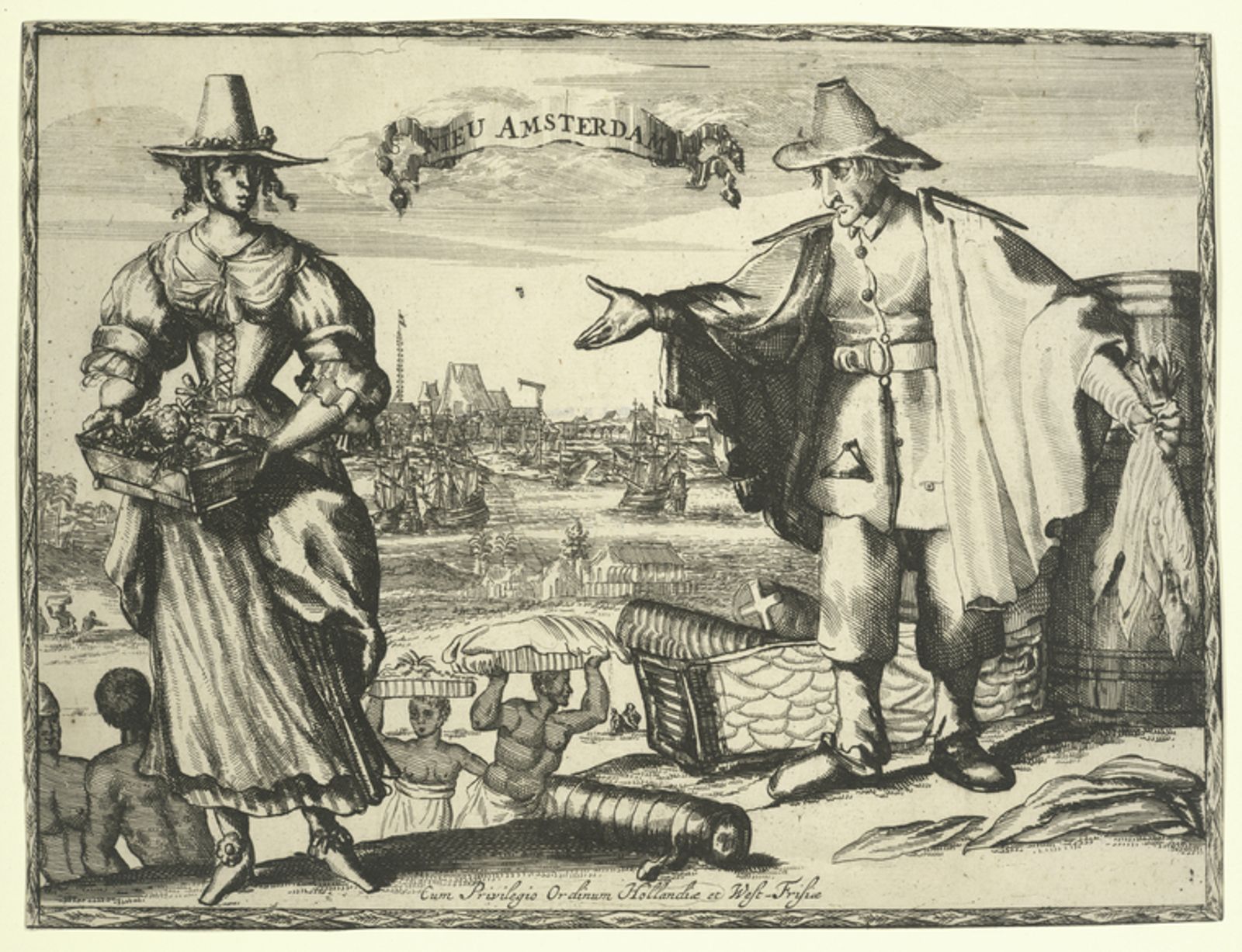
By the mid-seventeenth century, New Amsterdam had become a thriving Atlantic port whose streets echoed with many languages and cultures. Long before New York earned its modern reputation as a city of immigrants, its Dutch predecessor had already established that tradition.
Native Peoples and the Fur Trade
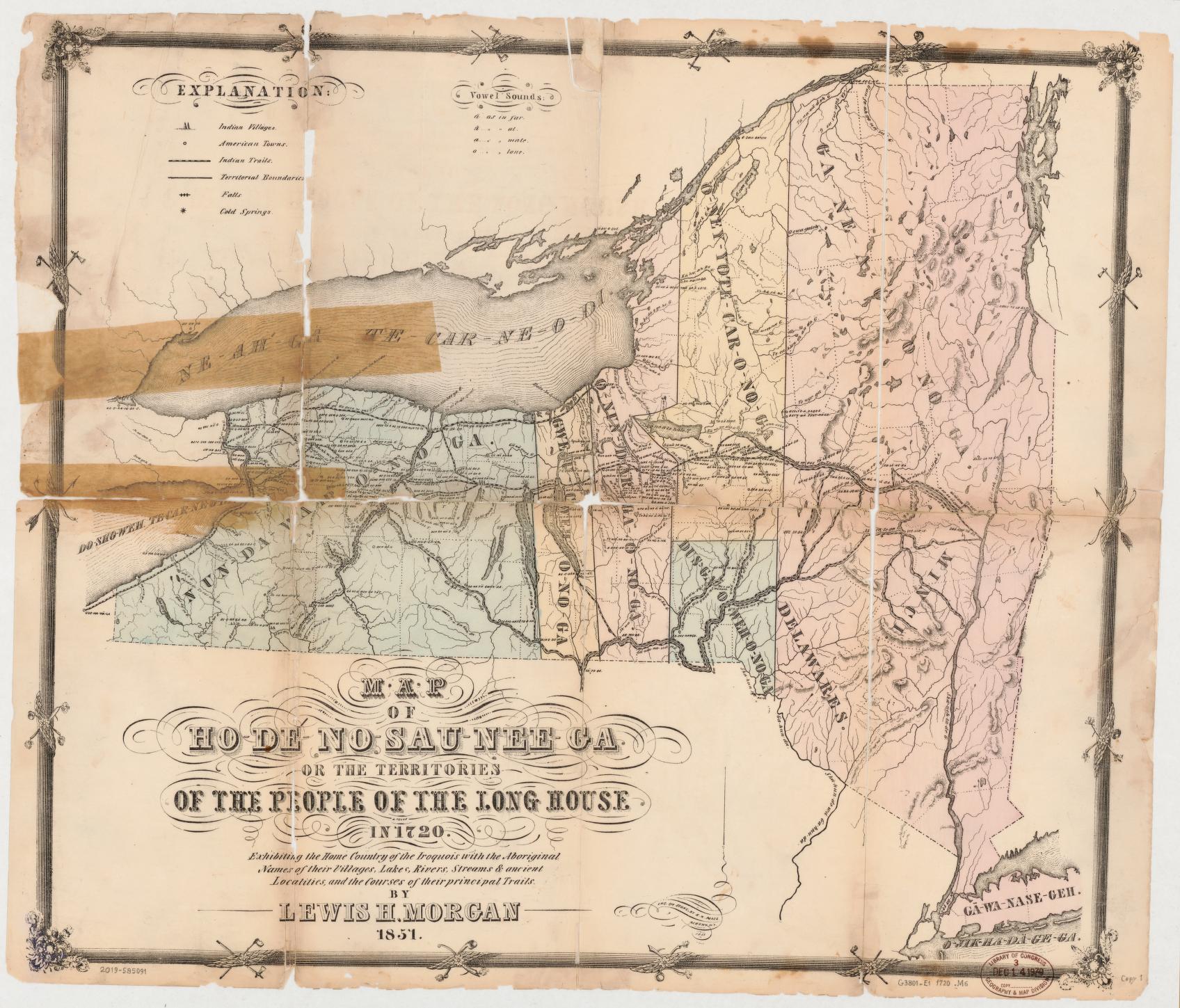
In the centuries before Europeans arrived, the region was home to numerous Indigenous nations. Most influential was the Haudenosaunee, or Iroquois, Confederacy, a powerful alliance of the Mohawk, Oneida, Onondaga, Cayuga, and Seneca nations, later joined by the Tuscarora. The Confederacy is increasingly referred to today by its own name, Haudenosaunee, meaning “People of the Longhouse,” although the term Iroquois remains familiar in historical literature. The Confederacy created one of the most durable and sophisticated political alliances in North American history, predating European settlement and exerting influence across much of the Northeast.
The fur trade became the foundation of New Netherland’s economy. Dutch traders exchanged European goods for beaver pelts obtained through Indigenous trade networks that extended deep into the interior. Fort Orange emerged as the principal center of this commerce, linking Atlantic markets with Native trading routes stretching toward the Great Lakes and beyond.
The trade generated substantial wealth for Kiliaen van Rensselaer, an Amsterdam merchant who established the patroonship of Rensselaerswyck near present-day Albany. His vast estate became one of the largest landholdings in colonial North America.
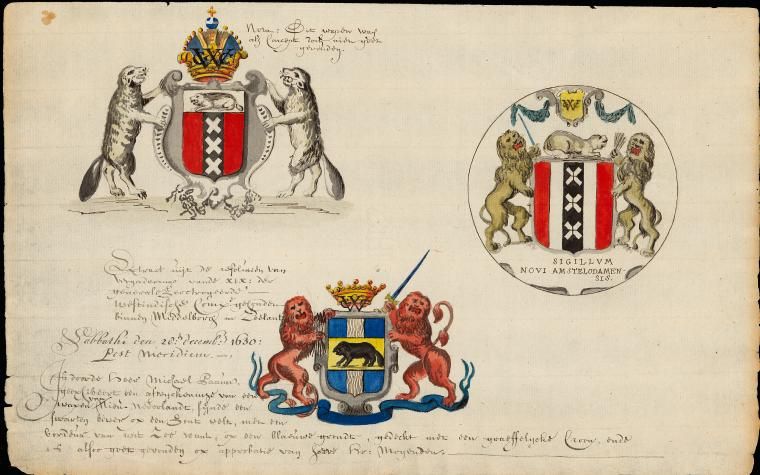
The trade generated substantial wealth for Kiliaen van Rensselaer, an Amsterdam merchant who established the patroonship of Rensselaerswyck near present-day Albany. His vast estate became one of the largest landholdings in colonial North America.
Native peoples were never passive participants in this system. They were diplomats, military allies, traders, and political strategists whose decisions shaped the colony’s future. The Haudenosaunee Confederacy skillfully balanced relations with competing European powers and maintained its influence for generations.
The strategic importance of Albany derived largely from these relationships. As the principal northern settlement of New Netherland, it became a meeting ground where Native leaders, traders, and colonial officials negotiated alliances, exchanged goods, and shaped the future of the region. The success of New Netherland depended as much upon diplomacy as commerce.
Religious Tolerance and Cultural Diversity
One of New Netherland’s most enduring legacies was its relative openness to religious diversity. Although the Dutch Reformed Church enjoyed official status, colonial authorities generally tolerated a broader range of beliefs than was common elsewhere in seventeenth-century North America.
This tradition arose less from abstract ideals than from the realities of commerce and governance. Merchants and officials found tolerance more practical than exclusion. Over time, however, that pragmatic approach evolved into one of the colony’s defining characteristics.
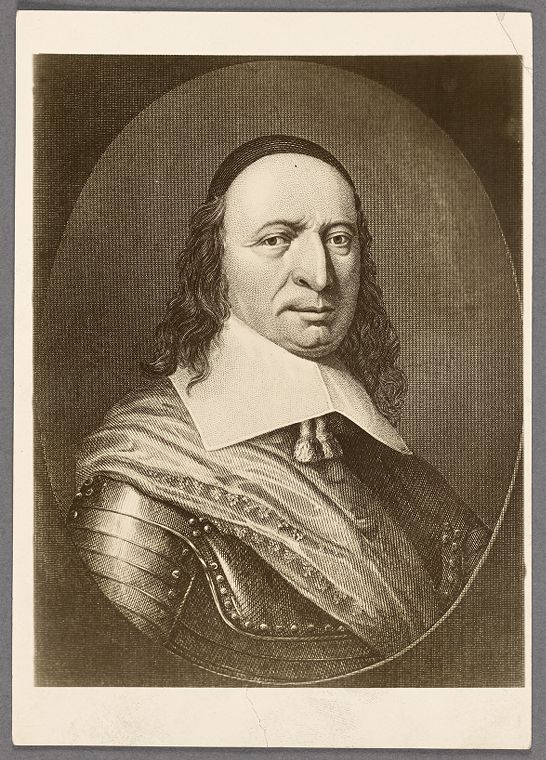
The limits of that tolerance became evident during the administration of Peter Stuyvesant, the colony’s final Dutch governor. Energetic, capable, and often authoritarian, Stuyvesant worked tirelessly to strengthen New Netherland’s defenses and expand its commerce. Yet he frequently clashed with groups whose beliefs differed from those of the established church.
Peter Stuyvesant had previously served the Dutch West India Company in the Caribbean and lost a leg during a military action on the island of Saint Martin, thereafter wearing the wooden leg that became part of his legend. Appointed Director-General of New Netherland in 1647, he inherited a colony facing administrative, military, and financial challenges.
During his seventeen-year administration, Stuyvesant strengthened defenses, improved public administration, expanded trade, and oversaw important public works. Under his leadership, New Amsterdam grew substantially in population and economic importance. Yet his forceful style often brought him into conflict with settlers who demanded greater local autonomy and with religious groups seeking broader freedom of worship.
Stuyvesant’s administration thus embodied both the strengths and limitations of Dutch colonial rule: energetic government, commercial success, and growing prosperity alongside recurring disputes over authority and religious tolerance.
In 1654, a group of Jewish refugees arrived in New Amsterdam after fleeing Portuguese Brazil. Stuyvesant sought to exclude them, but officials of the Dutch West India Company in Amsterdam overruled him. Their decision allowed the establishment of what became the oldest continuous Jewish community in the future United States and underscored the commercial and religious pragmatism that distinguished Dutch society.
"The law of love, peace and liberty"
Three years later, New Netherland witnessed one of the most significant episodes in the history of religious liberty in America. In 1657, residents of the Long Island town of Flushing presented a petition known as the Flushing Remonstrance in response to Stuyvesant’s efforts to suppress Quaker worship. Drawing upon Dutch traditions and Christian principles, the petitioners argued that liberty of conscience should be extended to all people, regardless of religious affiliation.
The Remonstrance declared that the signers could not, in good conscience, deny others the freedom to worship according to their beliefs. Although the petition did not immediately alter colonial policy, it became one of the most celebrated statements of religious liberty in early American history and foreshadowed principles later embedded in the nation’s constitutional tradition.
Taken together, the admission of Jewish settlers and the Flushing Remonstrance demonstrate that New Netherland’s tradition of religious tolerance was becoming an important element of the colony’s civic identity. While imperfectly applied and often contested, tolerance helped distinguish New Netherland from many of its contemporaries and left a lasting imprint on New York’s development.
Diversity extended far beyond religion. Africans, both free and enslaved, formed an important part of the population, while immigrants from across Europe brought new languages, customs, and traditions. By the time the English seized the colony in 1664, New Netherland had already established patterns of diversity and tolerance that would continue to shape New York for generations.
The English Conquest and the Preservation of a Dutch Legacy
The English conquest marked a turning point in New York’s history, but not a sharp break with its past. Unlike many colonial conquests, the transfer of New Amsterdam in 1664 occurred with remarkably little bloodshed, and many of the institutions, customs, and traditions established under Dutch rule survived long afterward.
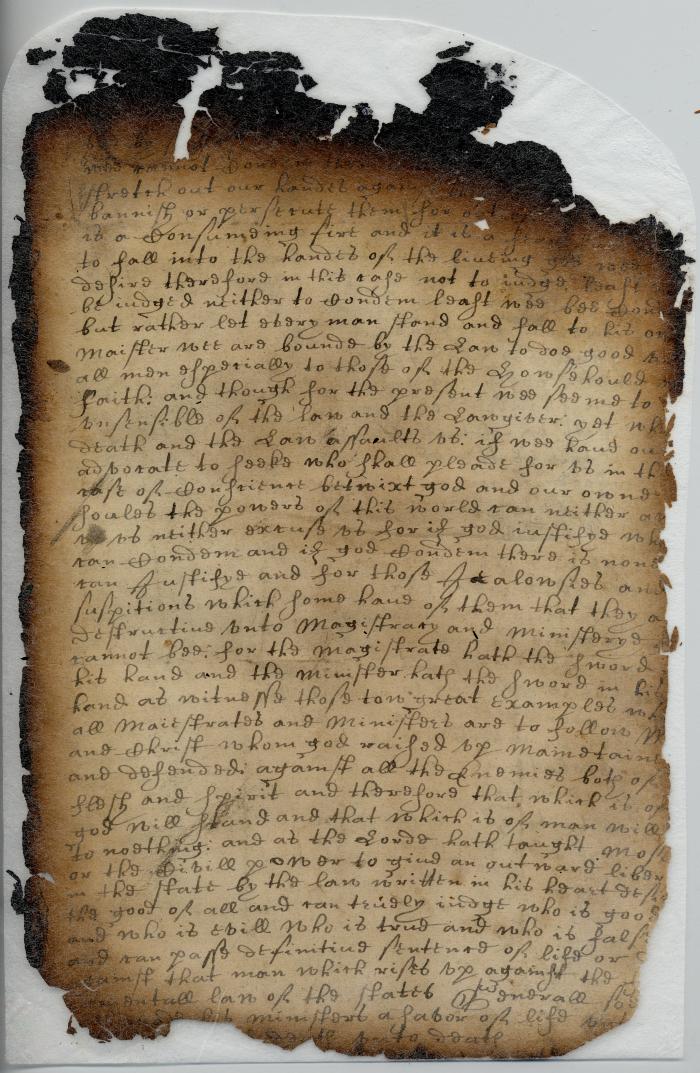
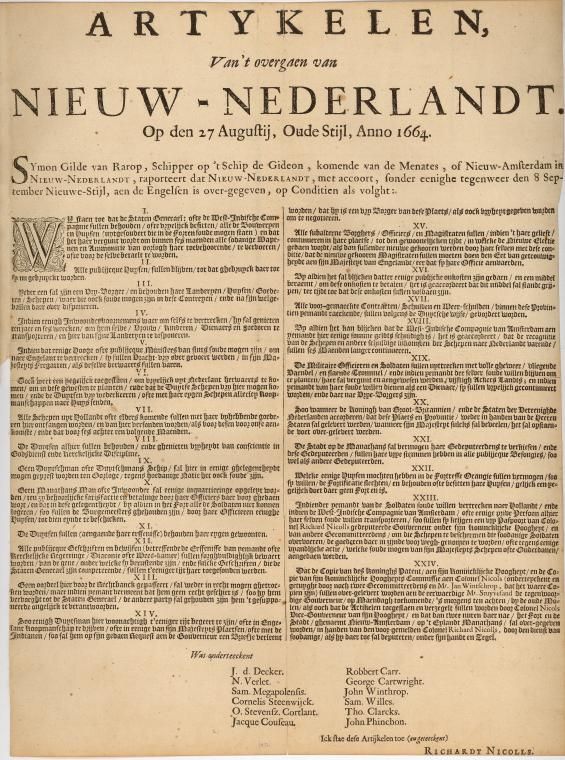
In 1664, an English fleet entered New York Harbor and demanded the surrender of New Amsterdam. Governor Peter Stuyvesant initially favored resistance, but many of the colony’s merchants and civic leaders saw little advantage in fighting. Faced with overwhelming force and limited public support, Stuyvesant agreed to surrender. The transfer of New Amsterdam to English control was one of the most consequential bloodless handovers in colonial American history.
The transition was overseen by Colonel Richard Nicolls, the first English governor of New York. A trusted representative of the Duke of York and one of four royal commissioners sent to strengthen royal oversight in New England and monitor developments throughout the region, Nicolls managed the transfer with notable pragmatism.
The Articles of Capitulation negotiated between the Dutch and English guaranteed the protection of property rights, inheritance, existing contracts, and freedom of worship. Nicolls honored those commitments, preserving Dutch legal customs and permitting continued religious practice.
His policies reflected both practical politics and the realities of a colony already accustomed to ethnic and religious diversity. In this respect, English rule reinforced rather than erased one of New Netherland’s most enduring characteristics.
The colony was renamed New York in honor of the Duke of York, the future King James II. Yet Dutch culture remained deeply embedded in society. Dutch churches flourished, Dutch continued to be spoken throughout much of the Hudson Valley, and Dutch legal customs persisted for generations.
The survival of Dutch traditions was particularly evident along the Hudson River. Communities stretching from New York City to Albany retained cultural practices, architectural styles, and patterns of local governance rooted in the colony’s Dutch past. Even as English institutions expanded, New York remained a society shaped by two colonial traditions. It’s worth noting that Peter Stuyvesant stayed in New York, lived there until his death, and is buried at St. Mark’s Church-in-the-Bowery, the site of a family chapel on his farm.
The English conquest therefore marked not the end of New Netherland’s legacy but its transformation. New York would become an English colony, yet it would remain profoundly influenced by Dutch traditions of commerce, local self-government, and religious tolerance.
Those traditions, combined with the colony’s strategic geography and longstanding relationships with Native nations, laid the foundations for the remarkable growth and influence New York would achieve during the eighteenth century.
Expansion Beyond Manhattan
Under English rule, settlement expanded dramatically beyond New York City. While the city remained the colony’s principal port and commercial center, much of colonial New York’s economic and political life unfolded along the Hudson River and in the interior.
Albany, formerly Fort Orange, retained its position as the colony’s gateway to the north and west. Situated near the head of navigation on the Hudson, it served as a center of the fur trade, a meeting place for Native diplomacy, and a strategic outpost linking the Atlantic world to the interior of North America. Few communities were more important to the colony’s future.
South of Albany, the Hudson Valley became one of the most productive agricultural regions in British North America. Wheat, livestock, and other products moved downriver to New York City and onward to markets throughout the Atlantic world.
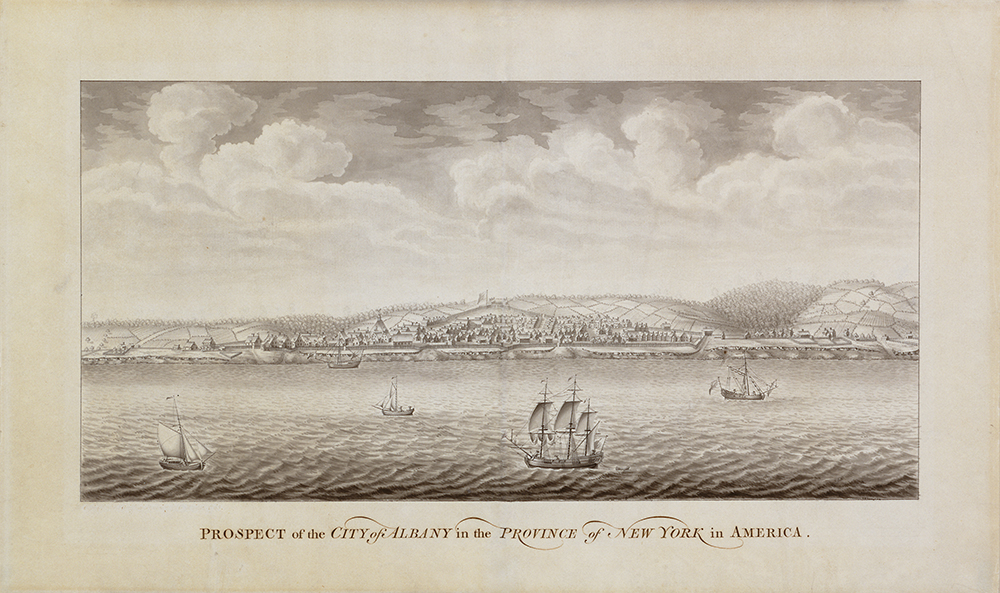
Kingston emerged as a thriving commercial and agricultural center, while Schenectady became an important frontier community linking the Hudson Valley to the Mohawk Valley and the lands of the Haudenosaunee Confederacy. Long Island continued to attract farmers and merchants, while settlement gradually spread northward and westward along the colony’s waterways.
No geographic feature shaped New York’s destiny more profoundly than the Hudson–Mohawk corridor. Together these river systems formed one of the few natural passages through the Appalachian barrier, connecting the Atlantic seaboard with the Great Lakes and the continent’s interior. Long before the Erie Canal, this route made New York a center of trade, migration, diplomacy, and military strategy.
The Great Estates and Colonial Society
The colony’s growth depended not only upon its towns and cities but also upon vast landed estates that dominated much of the Hudson Valley. Among the most important were the patroonship of Rensselaerswyck and the manors of the Livingston and Philipse families.
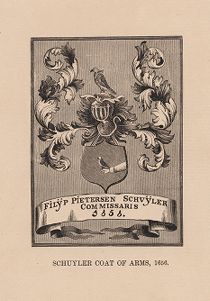
A small number of interconnected families, including the Van Rensselaers, Livingstons, Schuylers, and Philipses, exercised considerable influence over the colony’s economic and political life. Their estates helped drive agricultural production, expand commerce, and connect the Hudson Valley to the wider Atlantic economy.
These families were more than large landowners. They participated actively in trade, government, military affairs, and relations with Native nations. Their prominence illustrates how wealth, land, and political influence became concentrated in relatively few hands during the eighteenth century.
Yet colonial New York was far more than an elite society. Farmers, merchants, artisans, laborers, sailors, Native peoples, and enslaved Africans all contributed to its prosperity. The colony’s population reflected an extraordinary mixture of ethnic, religious, and cultural backgrounds that distinguished New York from nearly every other colony in British North America.
Politics and the Growth of Self-Government
Like many British colonies, New York experienced recurring tensions between royal governors and elected assemblies. Questions of taxation, military expenditures, land policy, and political authority frequently generated conflict.
The colony’s most dramatic political crisis followed England’s Glorious Revolution of 1688. Amid uncertainty over political authority, merchant and militia leader Jacob Leisler seized control of New York in 1689.
To supporters, Leisler defended Protestant liberties and protected the colony against arbitrary government. To opponents, he represented dangerous political radicalism and unlawful rebellion. When royal authority was restored, Leisler was arrested, tried, and executed.
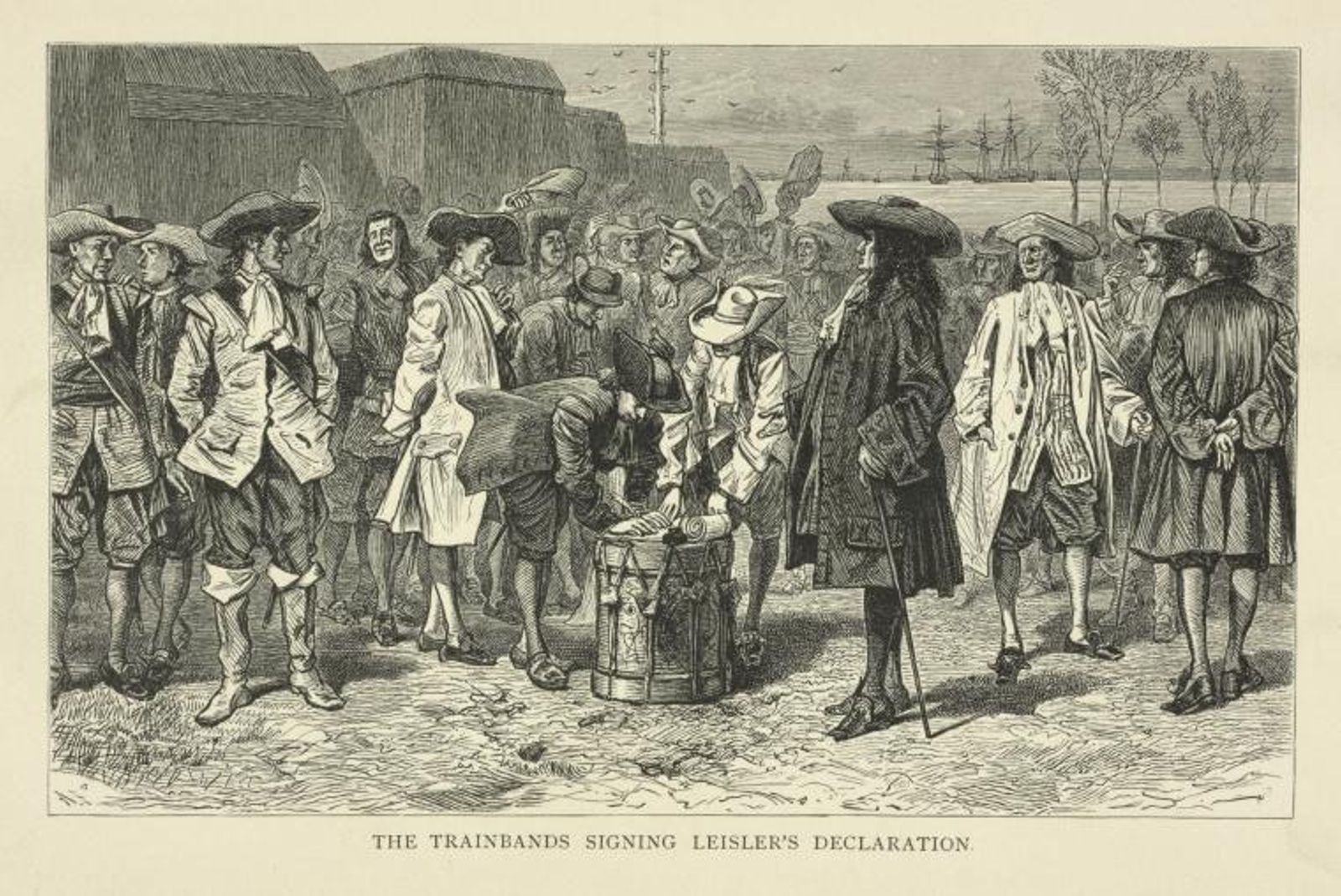
The controversy surrounding Leisler’s Rebellion divided New Yorkers for decades. More importantly, it revealed a growing willingness among colonists to participate directly in political affairs and foreshadowed later disputes over authority and representation.
By the eighteenth century, New Yorkers had developed a strong attachment to representative institutions. Elections, legislative debates, petitions, and public meetings became familiar features of political life. Although royal governors retained significant authority, they increasingly encountered colonists prepared to defend what they regarded as their traditional rights and privileges.
Religious Diversity Under British Rule
The English conquest brought the establishment of the Church of England as the colony’s officially supported church. Yet New York never developed the religious uniformity found in some other colonies.
Instead, the traditions inherited from New Netherland endured. Dutch Reformed congregations remained strong throughout the Hudson Valley, while Anglicans, Presbyterians, Lutherans, Baptists, Quakers, Huguenots, and Jews all established thriving communities.
The experience of the French Huguenots illustrates this pattern. Fleeing religious persecution in Europe, they established communities such as New Paltz and contributed significantly to the colony’s economic and cultural life.
This diversity survived because generations of New Yorkers had become accustomed to living alongside neighbors of different faiths. Commerce, immigration, and ethnic diversity reinforced a culture of religious tolerance that remained one of the colony’s defining characteristics.
Slavery and Society
Colonial New York was one of the most diverse societies in North America, but it was also one marked by profound inequalities. Wealthy merchants, large landowners, and political leaders occupied the highest ranks of society, while farmers, artisans, laborers, servants, and enslaved Africans formed the majority of the population.
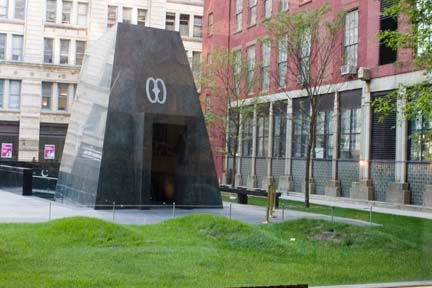
Slavery became deeply embedded in the colony’s economy. Enslaved men and women worked on Hudson Valley estates, in urban households, on docks and ships, and in skilled trades. By the eighteenth century, New York City had become one of the largest slaveholding urban centers in British North America.
Yet African New Yorkers were not merely laborers. They contributed significantly to the colony’s cultural and intellectual life. Among the most remarkable figures was Jupiter Hammon of Long Island, an enslaved poet whose published writings made him the first African American author to appear in print in British North America.
His work reminds us that even within a society shaped by bondage, enslaved people participated in the religious, cultural, and intellectual life of the colony.
Albany, the Haudenosaunee, and Imperial Politics
Throughout the colonial period, Albany occupied a unique position at the intersection of Native diplomacy, imperial rivalry, and colonial politics. No other community in British North America played a more important role in maintaining relations between colonial governments and the Haudenosaunee Confederacy.
For colonial officials, diplomacy with the Haudenosaunee was not a peripheral concern but a central element of imperial strategy. Alliances with the Confederacy helped shape the balance of power among Britain, France, and Native nations throughout northeastern North America.
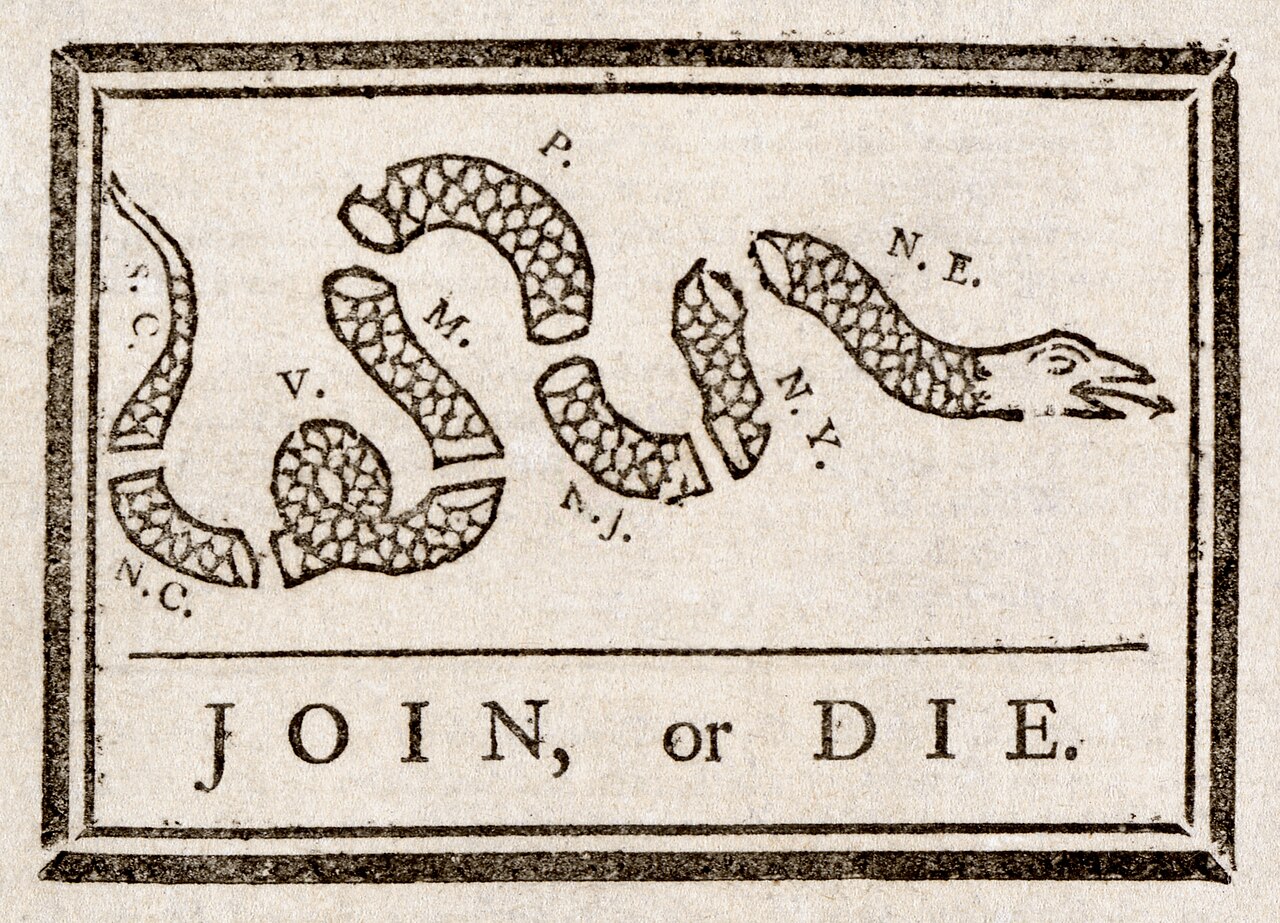
In 1754, representatives from seven British colonies gathered in Albany to discuss common defense and relations with the Haudenosaunee Confederacy. The Albany Congress reflected both New York’s strategic importance and the continuing influence of the Confederacy in imperial affairs.
Among the delegates was Benjamin Franklin, who proposed the Albany Plan of Union, one of the earliest schemes for coordinated colonial government. Although the plan was never adopted, it foreshadowed later efforts at intercolonial cooperation and ultimately the movement toward American union.
The Congress also underscored a larger reality: throughout much of the colonial period, Native nations were not simply subjects of European diplomacy but also active participants in it. The Haudenosaunee Confederacy exercised significant influence over relations among Britain, France, and the colonies and remained one of the most important political forces in northeastern North America.
War and Empire in Colonial New York
Throughout the colonial era, New York stood at the center of the struggle among European empires for control of North America. Its strategic position between New France and the British colonies, combined with its relationships with the Haudenosaunee Confederacy, ensured that military conflict repeatedly touched the colony.
During King William’s War (1689–1697), the North American phase of the War of the League of Augsburg, frontier communities faced raids and disruption as Britain and France competed for influence. The conflict revealed the vulnerability of New York’s northern frontier and underscored the importance of alliances with Native nations.
Queen Anne’s War (1702–1713), the American theater of the War of the Spanish Succession, again placed New York on the front lines. Military expeditions moved through the Hudson and Champlain corridors, while colonial leaders worked to preserve the alliance with the Haudenosaunee Confederacy. The war reinforced Albany’s importance as both a military and diplomatic center.
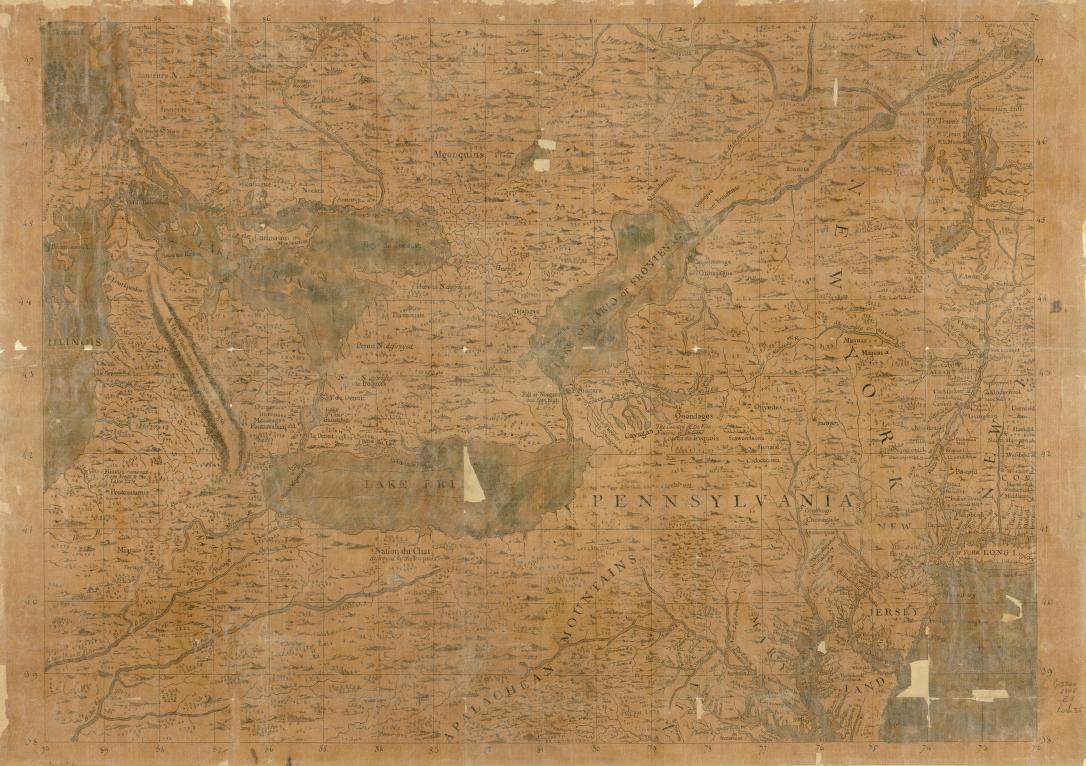
Imperial rivalry reached its climax during the French and Indian War (1754–1763), the North American phase of the global Seven Years’ War. Major campaigns were fought along Lake George and Lake Champlain, at Fort William Henry, Crown Point, and Ticonderoga, and throughout the northern frontier. More than any other colony, New York became the principal battleground between Britain and France, would determine the future balance of power on the continent
These wars shaped New York’s economy, politics, and society. They strengthened military institutions, deepened relationships with Native allies, and highlighted the strategic significance of the Hudson–Mohawk corridor. At the same time, the financial burdens imposed by Britain’s victory in 1763 contributed directly to the imperial tensions that would culminate in the American Revolution.
The Frontier
Throughout the eighteenth century, New York occupied the front line of the struggle between Britain and France for control of North America. The colony’s strategic position between Canada, New England, the Atlantic coast, and the interior made it a focal point of imperial rivalry.
No individual was more influential in frontier affairs than Sir William Johnson, who settled in the Mohawk Valley and became Britain’s Superintendent of Indian Affairs for the Northern Department. Through diplomacy, trade, and personal relationships, Johnson cultivated close ties with the Haudenosaunee Confederacy and became one of the most powerful figures in colonial New York.
Among Johnson’s most important allies was the Mohawk leader Hendrick Theyanoguin, known to the British as King Hendrick. A respected diplomat and warrior, Hendrick played a central role in relations between the Confederacy and the British during the mid-eighteenth century.
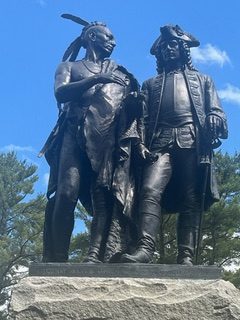
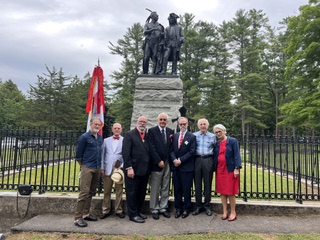
A monument overlooking Lake George, erected in 1904 by the Society of Colonial Wars in the State of New York, commemorates their partnership. The sculpture depicts Johnson and Hendrick discussing strategy before the Battle of Lake George in 1755. According to a well-known tradition, Johnson proposed dividing his forces, whereupon Hendrick broke a single arrow and then demonstrated that several arrows bound together could not easily be broken. The lesson was clear: unity was strength.
Whether literally true or refined through retelling, the story captures an essential reality of colonial New York: British success on the frontier depended heavily upon Native allies whose experience and judgment commanded respect.
Another important figure in this world of frontier diplomacy was Molly Brant (Konwatsi’tsiaienni), a Mohawk leader whose influence extended throughout both Haudenosaunee and British political circles. As a close associate of Sir William Johnson and a trusted intermediary between Native and British communities, she played an important role in maintaining political relationships during a period of rapid change. Her career illustrates both the importance of Indigenous diplomacy and the influential role that women could play within Haudenosaunee society.
Britain’s eventual victory eliminated France as a major rival in North America and secured New York’s northern frontier. Yet the enormous costs of the war also prompted Britain to impose new taxes and regulations on its colonies, setting in motion the tensions that would eventually culminate in revolution.
“Several arrows bound together could not easily be broken.”
Intellectual and Cultural Life
By the eighteenth century, New York had become more than a center of trade and diplomacy. It was also emerging as one of the foremost intellectual and cultural capitals of British North America. Newspapers circulated widely, books and pamphlets arrived from Europe and other colonies, and coffeehouses, taverns, and churches became places where public affairs were debated with increasing vigor.
As commerce expanded, so too did literacy and public engagement. Merchants, lawyers, clergy, and artisans participated in a growing culture of discussion that connected New York to the wider Atlantic world. Ideas about government, liberty, religion, commerce, and science moved through the colony alongside goods and people.
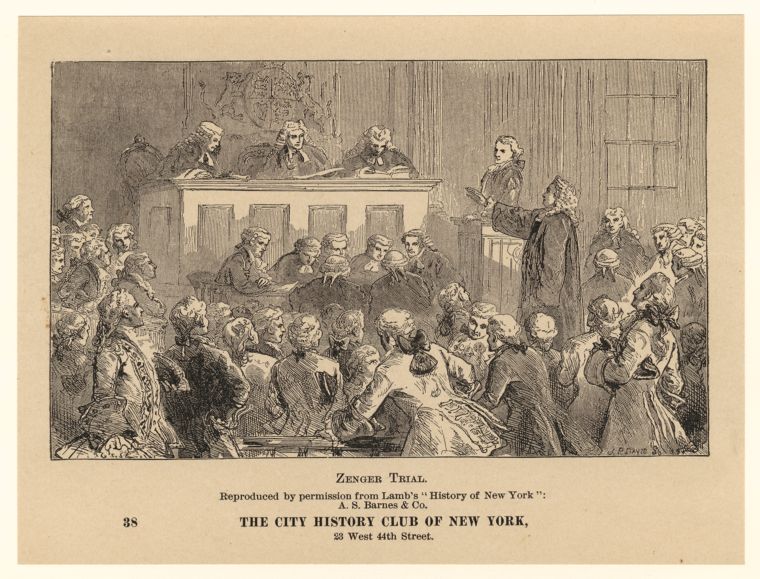
One of the most celebrated episodes in colonial New York occurred in 1735, when printer John Peter Zenger was tried for publishing criticisms of the royal governor. The case arose from political disputes within the colony, but its implications extended far beyond New York.
Although the legal principles involved were still evolving, Zenger’s acquittal became an enduring symbol of the importance of a free press and the right to challenge governmental authority. The trial helped establish New York as a center of political discussion and public debate and later assumed an honored place in the American tradition of freedom of expression.
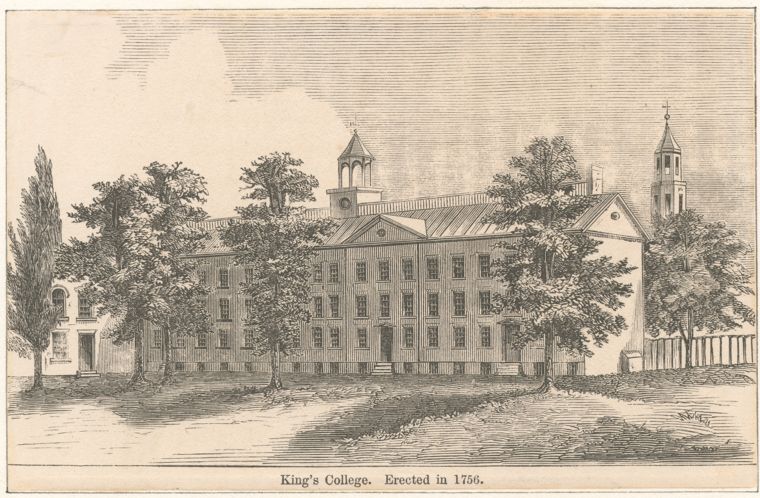
The colony also became an important center of higher education. In 1754, King’s College—later Columbia University—was founded in New York City. The institution reflected the colony’s growing wealth and cultural sophistication and would become one of the leading educational centers in British North America.
New York’s intellectual life extended beyond King’s College. Scientific inquiry, private libraries, literary clubs, and learned correspondence connected colonial New Yorkers to the broader currents of the Enlightenment. Merchants, clergy, physicians, lawyers, and public officials participated in an expanding Atlantic world of ideas, while newspapers and pamphlets helped create an increasingly informed public. By the eve of the Revolution, New York had become not only a commercial center but also a center of intellectual and cultural exchange.
The same forces that produced merchants, diplomats, and political leaders also fostered intellectual inquiry and artistic expression. By the middle of the eighteenth century, New York possessed a mature public culture whose institutions would help shape the revolutionary generation.
The Crisis of Empire
Britain’s victory in the French and Indian War transformed the political landscape of North America. France no longer threatened New York’s northern frontier, but the war left Britain heavily indebted. Seeking revenue to support imperial administration and defense, Parliament enacted a series of new taxes and regulations that many colonists regarded as violations of their rights.
Because New York was both a major commercial center and an important military post, these controversies were felt especially strongly within the colony. Merchants objected to restrictions on trade, while many colonists argued that taxes imposed without colonial consent violated the traditional rights of Englishmen.
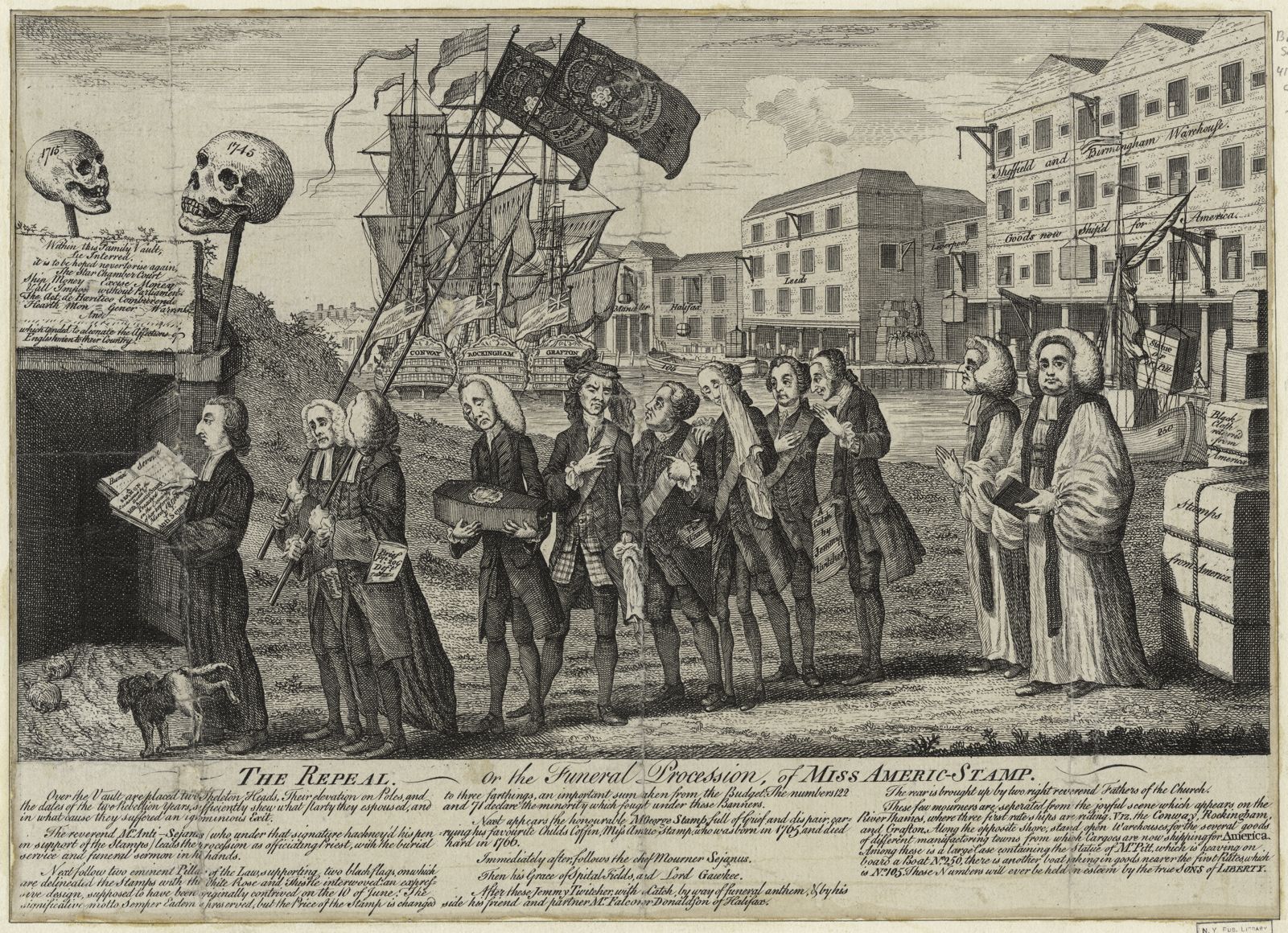
The Stamp Act of 1765 produced particularly intense opposition. Public protests erupted in New York City and elsewhere. Merchants organized boycotts, crowds demonstrated against imperial policies, and groups such as the Sons of Liberty emerged as powerful forces in colonial politics.
New York played a central role in the colonial response. The Stamp Act Congress met in the city in 1765, bringing together representatives from several colonies to coordinate opposition. Like the Albany Congress a decade earlier, the gathering demonstrated the growing willingness of colonists to think and act collectively.
The controversy surrounding the Stamp Act represented more than opposition to a single tax. It reflected deeper questions that had been developing for generations: Who possessed legitimate political authority? What rights did colonists enjoy? How should power be divided between local assemblies and imperial institutions?
These debates increasingly occupied the attention of New Yorkers from every level of society.
A Revolutionary Generation
As tensions with Britain intensified, a new generation of leaders emerged to guide New York through the crisis.
Among the most prominent was Alexander McDougall, a merchant, sailor, and veteran whose outspoken criticism of British policies made him one of the colony’s leading patriots. McDougall’s career reflected the growing willingness of New Yorkers to challenge imperial authority when they believed their constitutional rights were threatened.
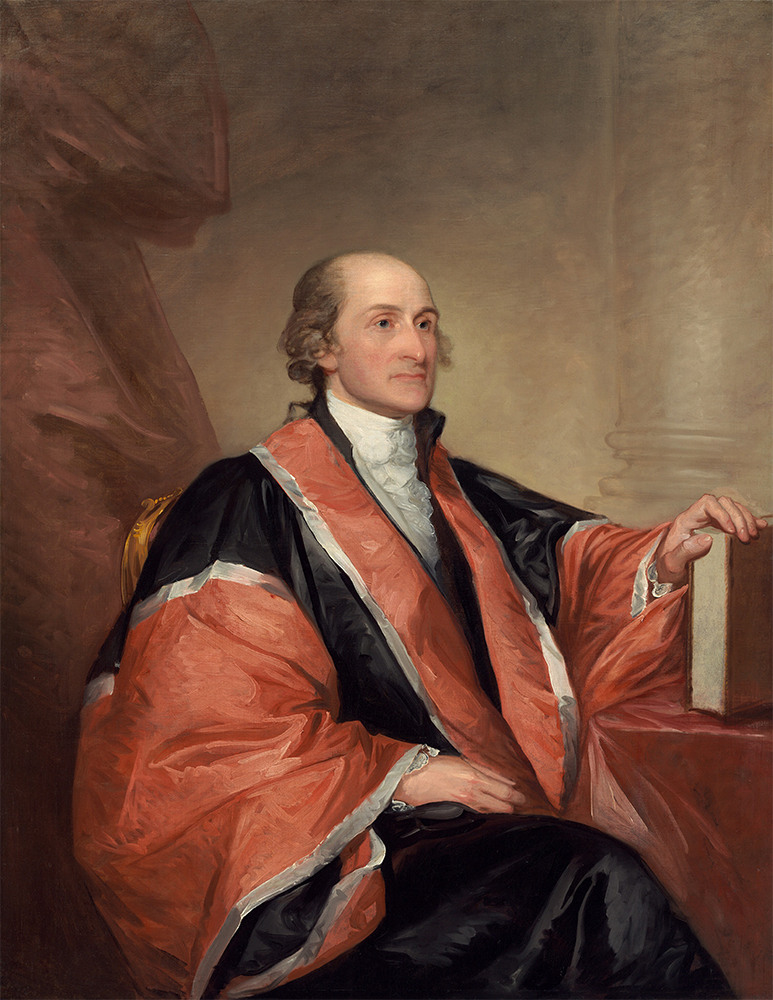
Another rising figure was John Jay, a young lawyer whose commitment to constitutional government and colonial rights would eventually make him one of the most influential statesmen of the new nation. Thoughtful, disciplined, and deeply engaged in public affairs, Jay represented the increasingly sophisticated political culture that had developed in colonial New York.
In the Hudson Valley, Philip Schuyler emerged as a prominent military and political leader. A member of one of the colony’s most influential families, Schuyler represented the participation of the landed elite in the patriot cause. Members of the Livingston family similarly became active in resistance to British policies, demonstrating that opposition extended beyond urban merchants and artisans.
Yet New York remained deeply divided. Many merchants, officials, clergy, and landowners retained strong ties to Britain, and loyalist sentiment remained substantial. The colony’s diversity of interests ensured that the coming Revolution would provoke intense debate and, ultimately, civil conflict.
Unlike some colonies where support for resistance developed relatively uniformly, New York contained strong patriot and loyalist communities, each convinced of the justice of its cause. The Revolution would divide families, neighborhoods, churches, and communities throughout the colony.
The Road to Revolution
By the early 1770s, resistance to imperial policies had become increasingly organized. Committees of correspondence, provincial congresses, and local political organizations mobilized opposition throughout the colony. Newspapers and pamphlets spread political arguments to a widening audience, while public meetings encouraged participation in civic life.
Many of the issues that now dominated political debate had deep colonial roots. Questions of representation, local self-government, religious liberty, and the limits of executive authority had surfaced repeatedly throughout New York’s history. From Adriaen van der Donck’s challenge to centralized authority and advocacy of local self-government, to the Flushing Remonstrance’s defense of liberty of conscience, to Leisler’s Rebellion and the Zenger trial, New Yorkers had long debated the relationship between authority and freedom.
When fighting erupted at Lexington and Concord in April 1775, New York stood at the center of events. Its strategic location, economic importance, and political influence ensured that it would become one of the principal theaters of the American Revolution. The colony that had begun as a Dutch trading outpost was now poised to play a decisive role in the creation of a new nation.
Conclusion: The Making of a Distinctive Colony
On the eve of the American Revolution, New York stood at the crossroads of empires, cultures, religions, and peoples. Its history has been shaped by Dutch merchants, English governors, Native diplomats, African laborers and intellectuals, immigrant farmers, frontier soldiers, religious leaders, and commercial entrepreneurs. No colony combined such geographic reach, ethnic diversity, economic vitality, and strategic importance.
The colony’s development rested upon several enduring foundations. Commerce connected New York to the Atlantic world and made New York City one of the most prosperous ports in North America. The Hudson and Mohawk river corridors linked the seaboard to the continent’s interior and made Albany, Schenectady, and the Mohawk Valley indispensable centers of trade and diplomacy. The diplomacy and military power of the Haudenosaunee Confederacy shaped relations among Native nations and European empires alike. Representative institutions fostered an increasingly active political culture, while religious tolerance encouraged a degree of pluralism unusual in the colonial world.
The colony’s history was shaped by remarkable individuals. Peter Minuit helped establish New Netherland’s commercial foundations. Adriaen van der Donck articulated an early vision of local self-government. Peter Stuyvesant presided over the colony’s final Dutch decades. Richard Nicolls guided its transition to English rule. Jacob Leisler reflected the colony’s evolving political culture. Sir William Johnson, King Hendrick, and Molly Brant demonstrated the central importance of Native diplomacy and frontier alliances. John Peter Zenger advanced the cause of a free press, while Jupiter Hammon’s writings revealed the intellectual contributions of African New Yorkers. In the years before independence, Alexander McDougall, John Jay, Philip Schuyler, and many others emerged as leaders of a new generation.
Yet the story of colonial New York belongs not only to its most prominent figures. It was equally shaped by Mohawk diplomats and Dutch farmers, by merchants in New York City and millers along the Hudson, by enslaved Africans and free Black communities, by Huguenot refugees, German settlers, English artisans, Jewish merchants, and countless others whose lives contributed to the colony’s growth and character.
Long before it became America’s largest city and financial center, New York had already developed many of the qualities that would define it for centuries—and continue to define it today. Its prosperity rested upon commerce, its strength upon diversity, and its stability upon a tradition—however imperfect—of religious tolerance among peoples of different backgrounds, faiths, and cultures. Positioned between Native and European worlds, between the Atlantic and the interior, and between the legacies of Dutch tolerance and British constitutionalism, colonial New York occupied a unique place in the making of America.
At the crossroads of peoples, faiths, and empires, colonial New York helped create the America that followed.
Further Reading
The New York Public Library's Colonial History Research Guide: New York State History – Colonial Period | NYSL
Blackburn, Roderic and Ruth Piwonka. Remembrance of Patria: Dutch Arts and Culture in Colonial America, 1609-1776. Albany: Albany Institute of History and Art, 1988.
Borneman, Walter. The French and Indian War: Deciding the Fate of North America. Harper Collins, 2006.
Mosterman, Andrea. Spaces of Enslavement: A History of Slavery and Resistance in Dutch New York. Cornell University Press, 2021.
Oberg, Michael. The Central Fire of the Iroquois: A Five-Hundred-Year History of the Onondaga Nation. Yale University Press, 2026.
Shorto, Russell. The Island at the Center of the World: The Epic Story of Dutch Manhattan and the Forgotten Colony that Shaped America. Vintage, 2005.
Shorto, Russell. Taking Manhattan: The Extraordinary Events that Created America. W.W. Norton & Company, 2025.
Works Cited
- Lionel Pincus and Princess Firyal Map Division, The New York Public Library. "Redraft of the Castello Plan, New Amsterdam in 1660" New York Public Library Digital Collections. Accessed June 22, 2026. https://digitalcollections.nypl.org/items/621026b0-c603-012f-3297-58d385a7bc34.
- Jansson, Jan. "Belgii novi, angliæ novæ, et partis Virginiæ: novissima delineatio." [Amsterdam: J. Jansson, 1657] Map. https://www.loc.gov/item/96686642/.
- "Henry Hudson's Half Moon," ca. 1909. September 2. Photograph. https://www.loc.gov/item/2005689539/.
- "Peter Minuit portrait." English Wikipedia, Public domain, via Wikimedia Commons.
- Morgan, Lewis Henry, Cartographer, and Richard H Pease. "Map of Ho-De-No-Sau-Nee-Ga: or the territories of the People of the Long House in: exhibiting the home country of the Iroquois with the aboriginal names of their villages, lakes, rivers, streams & ancient localities, and the courses of their principal trails: New York State." [Albany, N.Y.: publisher not identified, . Albany, N.Y.: Eng. on stone by R.H. Pease, 1720] Map. https://www.loc.gov/item/2019585091/.
- Manuscripts and Archives Division, The New York Public Library. "Coats of arms of New Amsterdam and New Netherland" New York Public Library Digital Collections. Accessed July 8, 2026. https://digitalcollections.nypl.org/items/5b631290-0032-0130-8416-58d385a7bc34.
- The Miriam and Ira D. Wallach Division of Art, Prints and Photographs: Print Collection, The New York Public Library. "Peter Stuyvesant" New York Public Library Digital Collections. Accessed June 24, 2026. https://digitalcollections.nypl.org/items/436f1cc0-3bf0-0130-6a03-58d385a7b928.
- New York State Archives. New Netherland. Council. Dutch colonial council minutes, 1638-1665. Series A1809. Volume 8.
- Rare Book Division, The New York Public Library. "Artykelen, van 't overgaen van Nieuw-Nederlandt" New York Public Library Digital Collections. Accessed August 27, 2026. https://digitalcollections.nypl.org/items/5f301f40-c548-012f-d3e3-58d385a7bc34.
- "Prospect of the City of Albany in Province of New York in America c. 1720." Attributed to Thomas Davies (1737-1812), probably after William Burgis (active 1717-1731), 1763. Watercolor and ink on paper. Albany Institute of History and Art, gift of Marjorie Doyle Rockwell, 1980.17.
- The Miriam and Ira D. Wallach Division of Art, Prints and Photographs: Print Collection, The New York Public Library. "Schuyler coat of arms, 1656." New York Public Library Digital Collections. Accessed September 14, 2026. https://digitalcollections.nypl.org/items/4dbaf740-c605-012f-d7e1-58d385a7bc34.
- The Miriam and Ira D. Wallach Division of Art, Prints and Photographs: Print Collection, The New York Public Library. "The trainbands signing Leisler's declaration" New York Public Library Digital Collections. Accessed June 29, 2026. https://digitalcollections.nypl.org/items/2ad50bf0-c5f0-012f-78bd-58d385a7bc34.
- The Miriam and Ira D. Wallach Division of Art, Prints and Photographs: Print Collection, The New York Public Library. "Nieu Amsterdam" New York Public Library Digital Collections. Accessed June 29, 2026. https://digitalcollections.nypl.org/items/19073860-c5ed-012f-3f5a-58d385a7bc34.
- "Memorial with Burial Mounds." Public Domain, via NPS.gov.
- "Join or Die." Benjamin Franklin, Public domain, via Wikimedia Commons.
- Etats-Unis: Partie septentrionale. [?, 1708] Map. https://www.loc.gov/item/gm71002152/.
- TBD
- The Miriam and Ira D. Wallach Division of Art, Prints and Photographs: Picture Collection, The New York Public Library. "Zenger trial" New York Public Library Digital Collections. Accessed June 29, 2026. https://digitalcollections.nypl.org/items/f149de20-c564-012f-610d-58d385a7bc34.
- The Miriam and Ira D. Wallach Division of Art, Prints and Photographs: Print Collection, The New York Public Library. "King's College. Erected in 1756." New York Public Library Digital Collections. Accessed September 14, 2026. https://digitalcollections.nypl.org/items/d1b55ca0-c606-012f-0b5d-58d385a7bc34.
- The Miriam and Ira D. Wallach Division of Art, Prints and Photographs: Print Collection, The New York Public Library. "The repeal, or the funeral procession of Miss America-Stamp." New York Public Library Digital Collections. Accessed June 29, 2026. https://digitalcollections.nypl.org/items/710dab60-c605-012f-7eaf-58d385a7bc34.
- "John Jay," Gilbert Stuart, 1794. Courtesy of National Gallery of Art, Washington DC.