
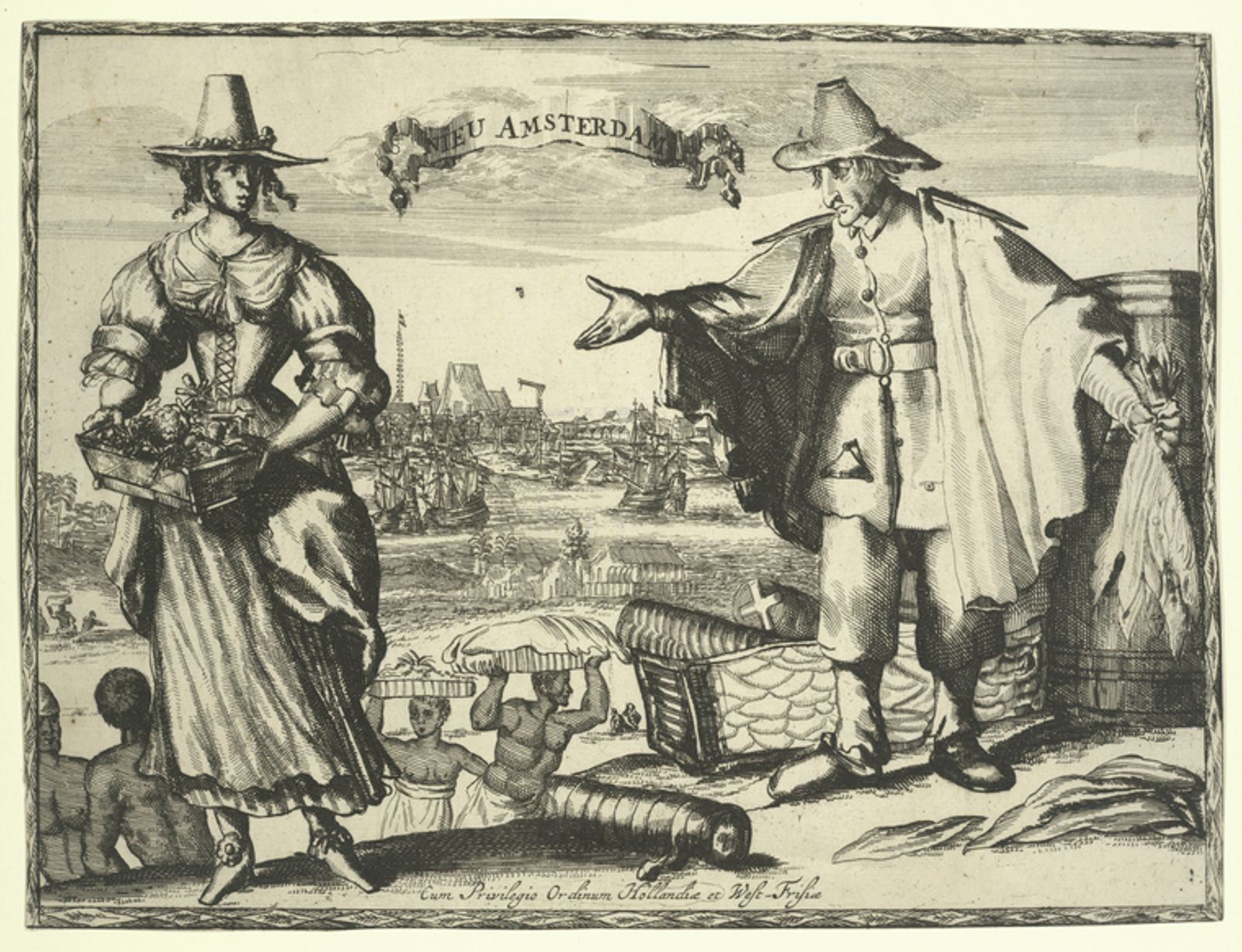
On August 29, 1627 the ship Bruynvisch arrived in the port of New Amsterdam carrying a small group of enslaved Angolan men, the first enslaved Africans to arrive in the Dutch New World. This marked the West India Company’s first foray into the slave trade, in part influenced by conflict over the Portuguese territories in Brazil and Angola.
While historical documentation of these men’s initial arrival remains vague, we do have a source dating from 1644 which may give insight into their names, and the experience of enslavement in early Dutch New York. A petition submitted to the Director and Council of New Netherland lists the names of eleven men, Paolo Angola, Groot Manuel, Cleijn Manuel, Manuel de Gerrit de Reus, Sijmon Congo, Antonij Portugis, Gracia, Piter Santomee, Jan Francisco, Cleijn Antonij, and Jan Fort Orainge, and asks that they and their wives be released from bondage after having worked for the West India Company for over a decade. It seems that they, and subsequent generations of enslaved Africans, including a woman named Reytory Angola, performed the labor of clearing the land granted to Dutch settlers by the Company - their arrival coinciding with the development of lower Manhattan and its early infrastructure. Following this petition, they were granted measures of “half-freedom,” including some plots of land in the Five Points area, where the African Burial Ground now stands.
Enslaved labor formed the backbone of the development of New Amsterdam and the wider colony, and was especially crucial to its rapid expansion in the latter half of the seventeenth century, with records indicating hundreds of people living in enslavement in the city by the 1660s.
Sources
Dewulf, Jeroen. “The Captives of the Bruynvisch (1627): New Insights into the Origins and Ladino Identities of Manhattan’s First Enslaved Africans.” Colonial Latin American Review 34 (3): 367-91.
Jacobs, Jaap. “‘Twenty-Two of the Healthiest Blacks”; The Ship Bruynvisch and the First Arrival of Enslaved Africans in New Amsterdam in 1627.” The Gotham Center for New York City History, June 26, 2024. https://www.gothamcenter.org/blog/arrival-enslaved-africans-zy4la-6h6h4.
Further Reading
Berlin, Ira and Leslie Harris. Slavery in New York. The New Press, 2005.
Brown, Emilyn. The African Burial Ground. New York: Municipal Archives of the City of New York, 1994.
Jacobs, Jaap. "The First Arrival of Enslaved Africans in New Amsterdam." New York History 104, no. 1 (2023): 96-114. https://dx.doi.org/10.1353/nyh.2023.a902905.
Mosterman, Andrea. Spaces of Enslavement: A History of Slavery and Resistance in Dutch New York. 2021.
New York Public Library. “NYC’s Early African American Settlements: New Amsterdam’s ‘Little Africa.’” https://libguides.nypl.org/nyc_early_africanamerican_settlements/new_amsterdam.