
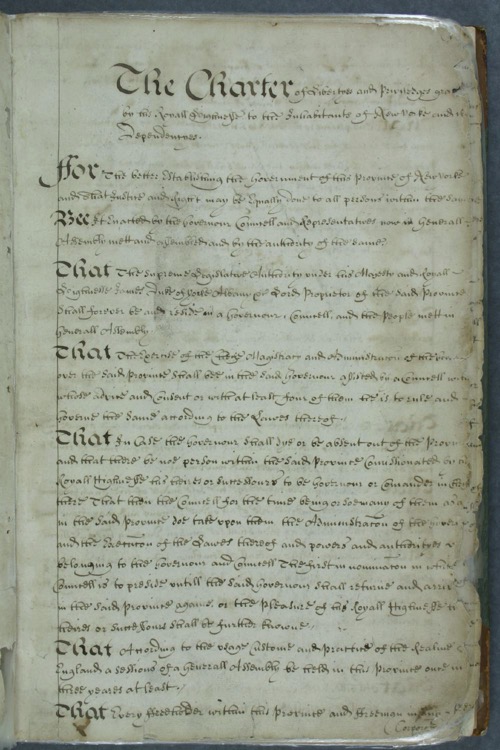
In 1683, the first meeting of the New York General Assembly drafted a document which laid out principles for the governance of the colony and the rights and freedoms of the colonists. While still operating under the authority of the King and Parliament of England, the Charter identified the assembly of colonists as a significant part of their own governance and organized the population into twelve counties. This followed similar structures which emerged in colonies like Pennsylvania and New Jersey, reflecting a wider trend of settlers moving towards a more individuated sense of self.
James, in his position as Duke of York, initially approved the charter and the colony operated under its guidelines for three years. In 1686, however, after becoming King, he repealed his confirmation of the document, and instead assimilated the colony into the Dominion of New England, citing the weakening of colonial authority represented by the general assembly. The assembly was not called to gather again until after the events of the Glorious Revolution and Liesler’s Rebellion.
Though never an official colonial policy, the Charter of Liberties and Privileges represents a formative early articulation of settler’s desires for a more representative government, and their sense of themselves as a corporate body separate from England. While still almost a century remained before the colonial congresses of the Revolution, the New York General Assembly’s assertion of their suffrage and political authority constitute an important early challenge to the crown’s control of their overseas colonies.
Sources
Wikipedia. “Charter of Liberties and Privileges.” https://en.wikipedia.org/wiki/Charter_of_Liberties_and_Privileges.
Historical Society of the New York courts. “British Colonial Charters.” https://history.nycourts.gov/about_period/british-colonial-charters/.
New York State Archives. “Charter of Liberties and Privileges (1683).” https://history.nycourts.gov/wp-content/uploads/2019/01/Publications_Charter-Liberties-1683-compressed.pdf.
Further Resources
Phelan, Thomas. Thomas Dongan: Colonial Governor of New York 1683-1688. Kessinger Publishing, 2008.